by Jean Marie Carey | 5 Dec 2013 | Animals, Animals in Art, Art History, Dogs!, Italian Greyhounds, Re-Enactments© and MashUps
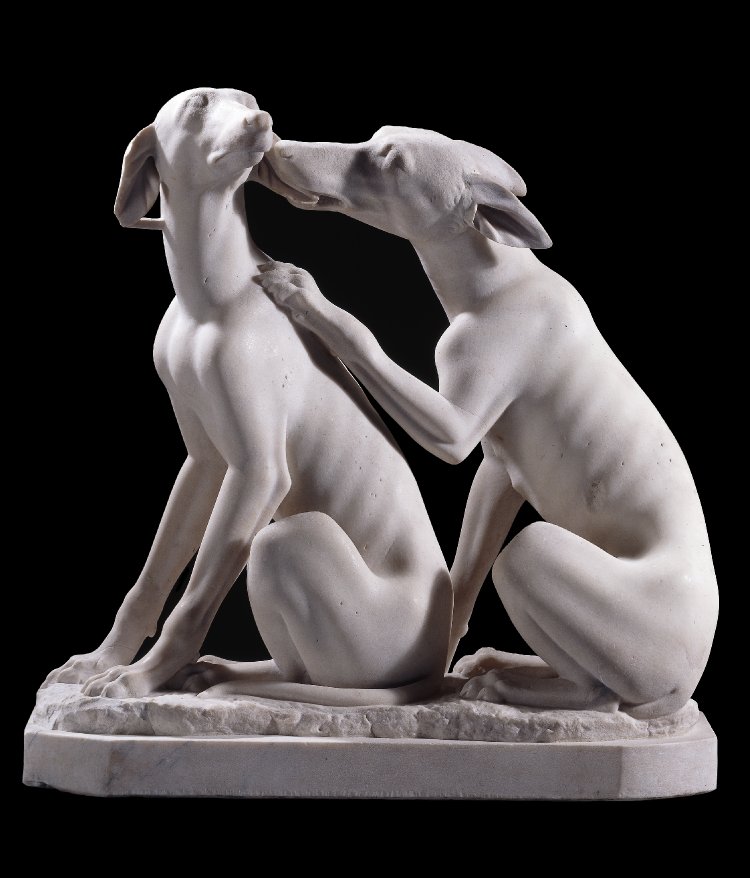
The Townley Greyhounds
The artistic expression of human relationships with animals has been and remains deeply complex and shifting. From the shaggy predators of the Lascaux Cave paintings to the costumed, hyperreal Weimareiners in the photos of William Wegman, the canine form has been especially popular with artists as both an ad hoc subject and a highbrow icon. A particular type of dog, the Cirneco dell Aetna, or Italian Greyhound, appears quite often in the art of ancient Greece and Rome, enjoying a commonality shared only with cattle and horses.
The Italian Greyhounds, however (as we shall call them henceforth), literally crossed the threshold in the ancient world, entering households not as steeds for work and war or sacrificial offerings, but as companions and objects of beauty.

The aim of this paper is to point out for consideration some examples of Italian Greyhound imagery from several ancient eras and geographical locations, to describe the history of this breed of dog in relation to its popularity in Greece and Italy, to draw a few conclusions about the dogs’ visual evolution and the reasons for its prevalence, and to show how both the animal and its image continued as both an influence and a viable species beyond the end of the Roman Empire. A starting point is to describe the nature and appearance of the Italian Greyhound, a species which exists fundamentally unchanged from its earliest days.
(more…)
by Jean Marie Carey | 21 Oct 2009 | Art History
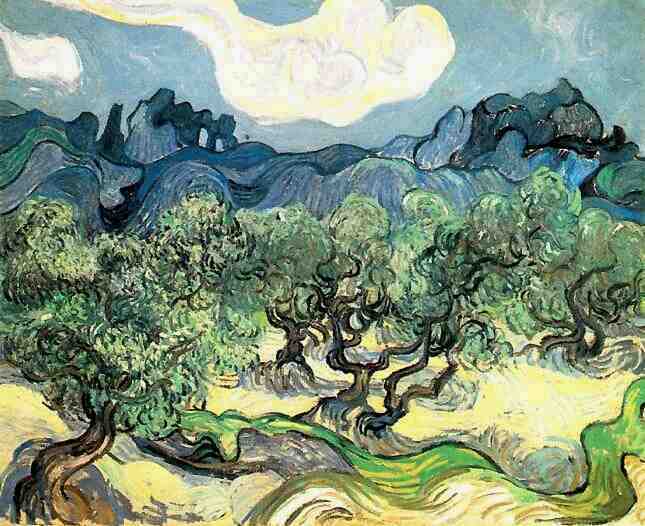
Van Gogh scholars Vojtěch Jirat-Wasiutyński and Joan Greer present comparative views – comparative in the sense that some aspects differ and some also agree – of Vincent Van Gogh’s production of olive-tree related paintings during his slightly-longer-than-one-year stay in Saint-Rémy beginning in May 1889 in the respective articles “Vincent van Gogh’s Paintings of Olive Trees and Cypresses from St.-Rémy” and “A Modern Gethsemane: Vincent Van Gogh’s Olive Grove.” While both pieces emphasize the storied Biblical association of olive trees and olive groves and explore various aspects of Van Gogh’s perception and representation of himself as a Christic figure, Greer brings forward some interesting arguments concerning Frédéric Salles, a Reformed Church minister who visited Van Gogh at Saint-Paul-de-Mausole and became involved with the artist and his family, and about the possibility of Van Gogh’s intentions around these paintings to engage in a sort of conversation with Emile Bernard and not-so-subtle reproach to Paul Gauguin about observation vs. memory studies and religious iconography. Jirat-Wasiuty?ski proposes as an aside that Van Gogh’s cypresses constitute references to Egyptian art (as invocations of immortality) and that the olive series also furthered Van Gogh’s earlier pursuit of typology and physiognomy in attempting to locate the nostalgic and essential in Provencal culture. Finally, Vojtěch Jirat-Wasiutyński makes some points about Van Gogh’s identification olive and cypress trees not as religious symbols but as relatable organisms. “Both trees were treated as tough outcasts, relegated to marginal land,” Vojtěch Jirat-Wasiutyński observes on page 650.
Greer is persuasive in her account of Salles’s appearance in Van Gogh’s life as a sympathetic figure and one whom Van Gogh could fix some of his yearning for connection upon and as a vector for rekindling connections to Protestantism. Viewed this way, Van Gogh’s representations of himself as a Christ seem more grounded in the longstanding tradition of post-Reformation artists to show themselves this way (such as Albrecht Durer’s most famous self portrait). This type of representation springs not from hubris, but from the belief that man is made in God’s image. Speaking of hubris, though, this does not account for Gauguin’s Christic delusions (coming from a Catholic family it is further mortifying to learn that Gauguin also poorly represents us – this man is a constant disappointment on every level). As to Van Gogh’s dialogue with Bernard and Gauguin, certainly this is a possibility – Van Gogh probably (in reference to conversations which may have taken place in Paris) entertained the hope of “getting the band back together.” (more…)

