by Jean Marie Carey | 3 Aug 2008 | Art History
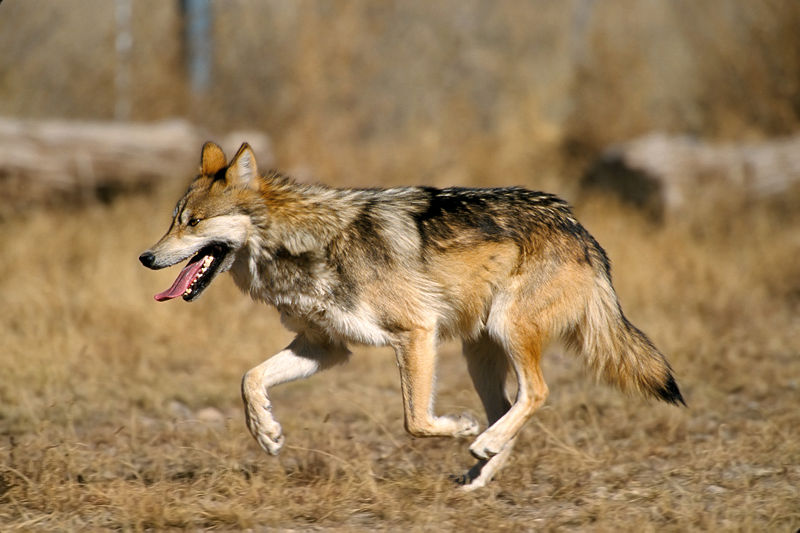
Mexican red wolf, courtesy U.S. Department of the Interior
Following, Christopher Nolan, (1998) ••••; Haven, Frank E. Flowers, (2004) ••••; Love Liza, Gordy Hoffman, (2002) •••••; Armistead Maupin’s Further Tales of the City, Pierre Gang, (2001) ••; Disturbia, D.J. Caruso, (2007) •••; The Last Emperor, Bernardo Bertolucci, (1987) ••••

by Jean Marie Carey | 27 Jul 2008 | Animals, Art History
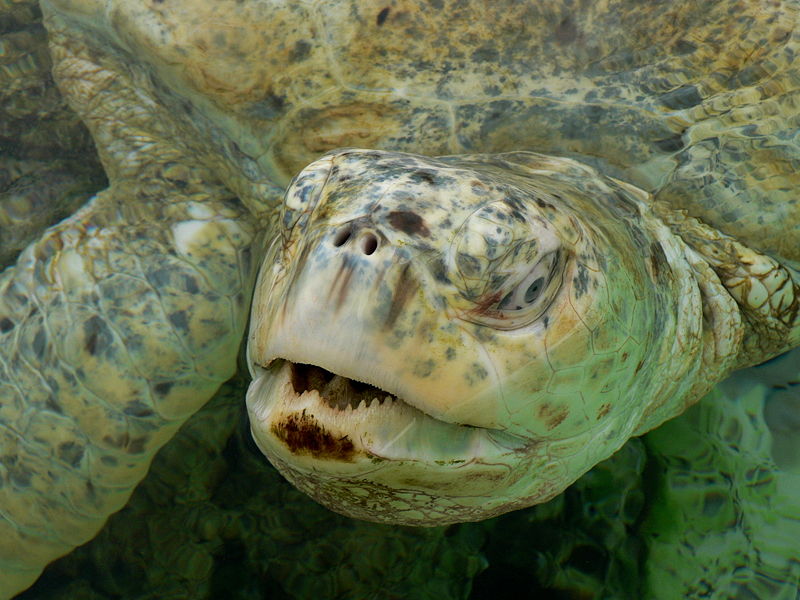
[Green turtle, albino. By David Monniaux]
“To photograph is to appropriate the thing photographed.”
On Photography, Susan Sontag’s exhaustive critique of photography, which excoriated photographers even as it elevated the art form, opens (in the 1977 book form of the collected essays) with the chapter “In Plato’s Cave.” Arranged and edited in this manner this chapter is meant to serve as the introduction to Sontag’s collection of ideas on the sociological implications of the medium of photography.
So much has been written by and about Sontag with respect to the construction and importance of these essays, and so much biographical detail about Sontag has come to light since her death a few years ago, that is it difficult to consider “In Plato’s Cave” unto itself, separate from that information, let alone separate from the other essays in the collection.
Basically, Sontag takes humankind to task, as did Plato, for sitting around accepting whatever images that happen to dance past as a perfect mirror (or projection) of reality and judges photographers equally harshly for approaching their subjects with acquisitiveness and predation. Sontag investigates the simile of the cave but more deeply the metaphor of the mirror.
I was interested to learn that Sontag had also written extensively about Persona, the 1966 Ingmar Bergman film, probably around the same time she began the series of essays that are collected in On Photography. Persona can also be construed as being about mirroring, and also about a kind of (seemingly) passive transmission and reception of knowledge, as well as a complicated examination about the relationship between the beholder and the beheld. Persona is open to interpretation as a horror movie rather than a psychological study, one in which a very modern sort of vampire sucks the being from a similar but not identical human. (more…)
by Jean Marie Carey | 3 Jul 2008 | Animals, Animals in Art, Art History
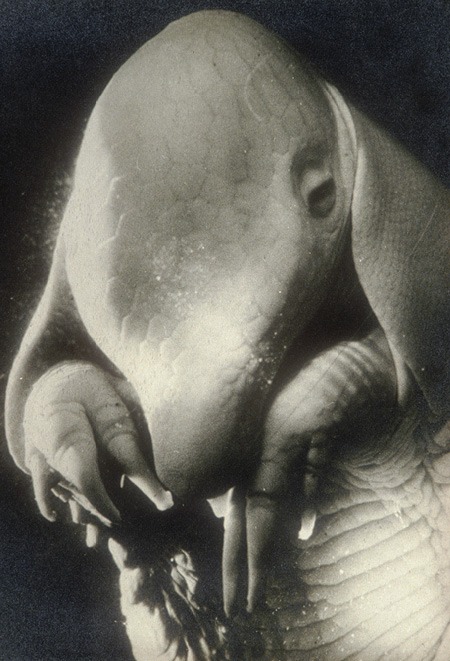
Pére Ubu by Dora Maar, 1936
Authorship by Dora Maar gives this photograph authentic historic and even feminist credibility but I chose it because my main interest in art overall is the representation of animals. This is a very interesting view of a creature commonly seen in Florida (and all over), an armadillo (though this armadillo is of a different species than the nine-banded creatures who sadly cannot navigate traffic).
There is something primitive and otherwordly about armadillos and whatever Maar’s intent may have been in elevating such a seemingly lowly creature into this eerie portrait it is quite a lovely study. Since Maar was interested in primitivism, this seems apt.
With respect to technique, placing the pale, scaly armadillo against a grainy dark background removes it from a natural setting and allows for contemplation of the texture of its skin. The shadows on its chest accentuate its claws. There is no way to tell, framed in this manner, how big the armadillo is, whether he is, as Maar’s title suggests, “king” sized, or tiny like a fetus, which the armadillo also resembles.
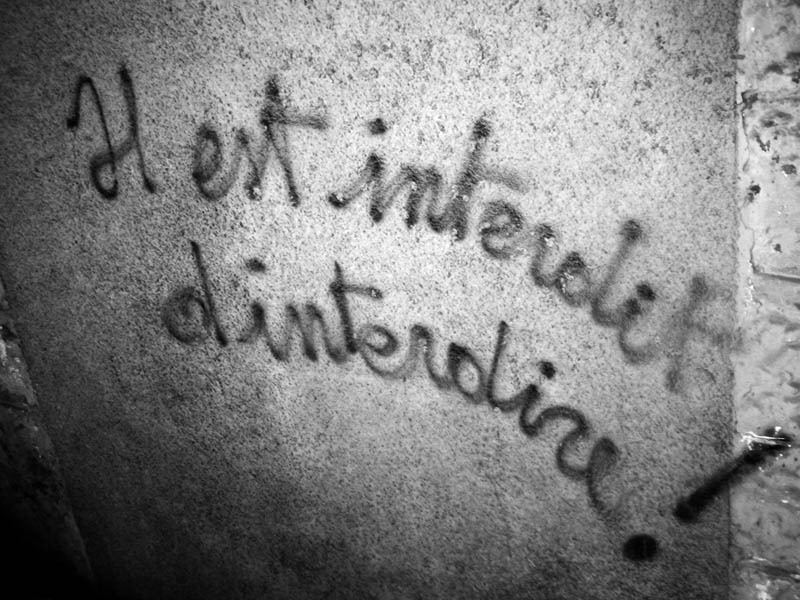
by Jean Marie Carey | 13 Jun 2008 | Art History, Re-Enactments© and MashUps
Situationist grafitti, Menton, Occitania, 2006 (the 1968 slogan “It is forbidden to forbid”, with missing apostrophe). Wikipedia Commons
“Rather — just as certain biologists argue for the maintenance of species diversity among plants in order to preseve them for potential use by future generations — we should battle on the side of the obscure, the small, the powerless, the marginalized in order to maintain bio-diversity of memes, of ideas and aesthetic and imaginary realms.”
Marina LaPalma’s “Situationism: A Primer” is one of the best readings in existence for art history students because it is very easy to digest, in terms of distilling the much more difficult prose of situationists from the 1960s, particularly Guy Debord, but also because it is a call to action that clearly illuminates some of the social conditions to be acted against.
Written in 1988 in honor of the approximate twentieth anniversary of the publication of The Society of the Spectacle, “Primer” notes that the intervening decades have made DeBord’s observations seem even more absolutely correct. (Time has done the same for “Primer.”) LaPalma describes a completely dystopic society, yet in the last quarter of the article makes clear that her intent overall mood is hopeful.
Like the original SI group, LaPalma makes a few incorrect assessments, identifying simple sociopathy (“Can any pleasure we are allowed to taste compare with the indescribable joy of casting aside every form of restraint and breaking every conceivable law?”) and the Los Angeles riots as appropriations of situationism.
Yet many – most – of LaPalma’s statements about the Spectacle, like DeBord’s, seem even more valid today than when written: “The world we see is not the real world, it is the world we have been conditioned to see; a world constructed from the black and white of tabloids, a world framed by the mahogany veneer of the television set, a world of carefully constructed illusions – about ourselves, about each other, about power, authority, justice and daily life. A view of life from the perspective of power.”
LaPalma uses the commodification of superficially “rebellious” music (punk and techno) to illustrate the idea of recuperation, and is also, mercifully, extremely critical of hippie-collectivist modes of dropping out. “Revolution is a process, a process that can be started now,” says LaPalma.
The problems – isolation through the work/home/consumer system, totally immersive media that purports to broadcast reality, the replacement of the citizen by the consumer – are clear. The extremity of the endless war, continuous states of celebrity meltdown, and now, recession, makes action seem like the only choice. LaPalma does not provide any guidance for resisting the Spectacle within society without perpetuating it.

by Jean Marie Carey | 29 May 2008 | Art History
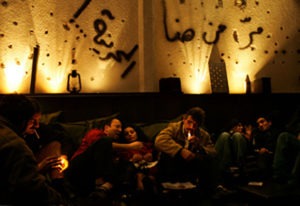 Nightclub in Beirut, Lebanon (Stephanie Sinclair, 2005)
In July of 2006, during a bout of intense border battles between Israeli armed forces and members of Lebanon’s Hezbollah militia, a photograph made by Stephanie Sinclair achieved a broad second life on the Internet when it accompanied a post on food writer and Travel Channel star Anthony Bourdain’s blog; Bourdain and crew had been filming an episode of No Reservations in Beirut and were “trapped” in the city owing to the destruction of the airport and an naval blockade effectively halting departures by Americans from the Gulf states. The photograph had originally appeared on March 12, 2005, in the Travel section of the New York Times with a story by Scott Spencer about the nonchalant nightlife scene in Beirut following the assassination of Lebanese prime minister Rafik Hariri. The image was described in the Times as “Love among the ruins at the war-themed Beirut club known as 1975,” and on Bourdain’s blog with the following caption: “Prewar partygoers enjoy the music and atmosphere at 1975, a bar whose theme is the country’s civil war.”
The odd syntax of the cutlines suggests that “the war” was an omnipresent future, past, and present entity. Regardless of the date the image was made, though, its placement in the context of stories about a “live,” ongoing military flare-up, even amid the larger ceaseless tragedy in the Middle East, makes the powerful suggestion that Beirutis party even as rockets and air strikes devastate the buildings around them.
(more…)
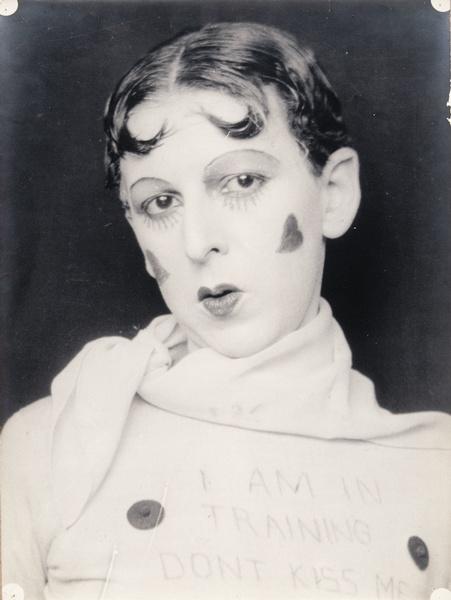
by Jean Marie Carey | 18 May 2008 | Art History
Claude Cahun Self Portrait, 1927. Collection Musée des beaux-arts, Nantes.
In her essay “In Our Glory: Photography and Black Life,” bell hooks uses a story about the relationship she and her two sisters “V.” and “G.” have to a photograph of their father, Veodis Watkins, taken before the girls were born, to set up a general dialogue about the function of snapshot collection displays in African American households and the role these photos play in construction and possession of black identity. Though a very prolific writer who mostly espouses disengagement from the concept of “the enemy,” hooks frequently chooses unusual adversaries (among them rapper Lil’ Kim and filmmaker Wim Wenders). In “In Our Glory” hooks’s rival is her sister “V.”
(more…)