by Jean Marie Carey | 8 Feb 2011 | Animals, Animals in Art, Art History, Dogs!, Franz Marc, German Expressionism / Modernism, Italian Greyhounds, Stuff Found in Library Books
Fabeltier, Franz Marc, 1912
This is a really big week for birthdays: Bob Marley on 6 February (1945) [“it takes a revolution to make a solution”] and Saint Thomas More on 7 February (1478). More and more scholars agree ...the New Isle Called Utopia is a true socialist manifesto and I concur!
Most importantly though, 8 February (1880) is the birthday of painter, writer, animal sanctuarist, soldier, and millinery fashion icon Franz Marc.
Fabeltier (1912) is a plate from Der Blaue Reiter. Is the image a tiny (Italian Greyhound-looking) fanciful creature by a regular-size strawberry, or a giant strawberry with a little dog, or something else? I don’t know; it’s just fun and mysterious. Marc made a few illustrations like this called various iterations of Fabeltier but like gargoyles the animals resemble dogs, horses, lions…I especially like this one but they are all fantastic.

by Jean Marie Carey | 13 Jun 2010 | Art History, Franz Marc, German Expressionism / Modernism
Franz Marc’s best known writing is his public manifesto-ing, and also his correspondence with colleagues and family. But Marc also wrote on the covers of and inside his various sketchbooks all the time. This verse from around 1910 is really trippy in a Rimbaud sort of way. Some of the imagery and words come up again in paintings and painting titles. Thomas de Kayser, the editor of the volume in which this appears, organizes this material by theme very agreeably. Text in French follows the English translation.
Notes in the sketchbook XXVIII
— A pink rain fell over meadows.
— The air is like green glass.
— The girl [observed] looked into the water, the water was clear [as] crystal, the girl was crying.
— Trees had their growth rings, the animals their veins.
Notes in the sketchbook XXXI
The storm roared.
I entered the house and saw all
A tall woman red small black cat [playing] on the green table.
Kraak, lightning strikes the vehicle – the beautiful little cats were playing with the woman, she smiled – ah ah [poor] man and horse are [is] dead. [The man cries] [sky] the angel of fear knocks at the window; the [poor woman] I could shake the red heart of the woman and black kittens knew the green table – what it [?], red and black and green? Three colors give it a thought? If we give to the red heart shape, the black that [one of three interspersed] small kittens, green form of [a large square plate ?…] the square.
I meditate on that thought.
The red heart of the woman breaks.
It [comes] springs a [blood …] [a streak of blood] A stream of blood [across the sky due] which falls into the river, it flows through the now red green pastures grazed by sheep or black.
The storm has withdrawn his hand from the earth.
The blue sky [?] Ogle like a gigantic glass eye the scene [of] red, green, and black, this thought is not it terrible? […] Do you understand what the painters paint?
(more…)
by Jean Marie Carey | 18 May 2010 | Art History, German Expressionism / Modernism
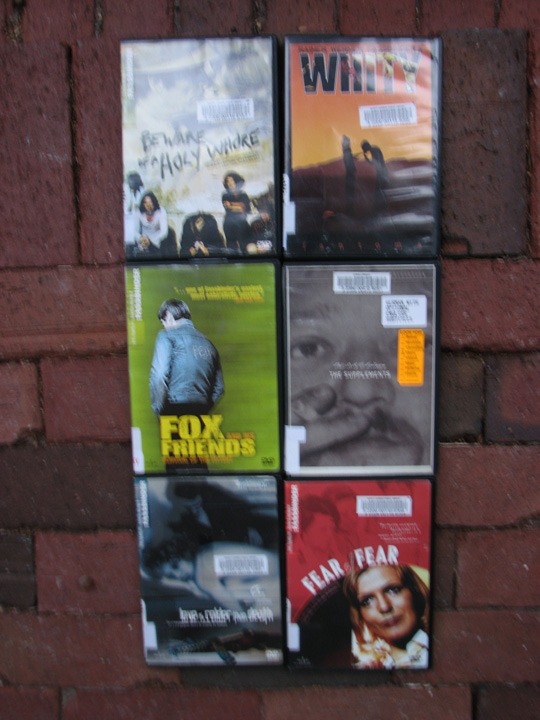
Phassbinder Philm Phestival
Whity, (1971); Warnung vor einer heiligen Nutte, (1971); Faustrecht der Freiheit, (1975); Angst vor der Angst, (1975); Liebe ist kålter als der Tod, (1969); Die Sehnsucht der Veronika Voss (1982); Die Ehe der Maria Braun, (1979); Lola (1981).
Rainer Werner Fassbinder: Few filmmakers so powerfully manage to subvert desire for cathartic drama while simultaneously fulfilling it.