by Jean Marie Carey | 2 Dec 2011 | Animals in Art, Art History, Dogs!, Franz Marc, German Expressionism / Modernism
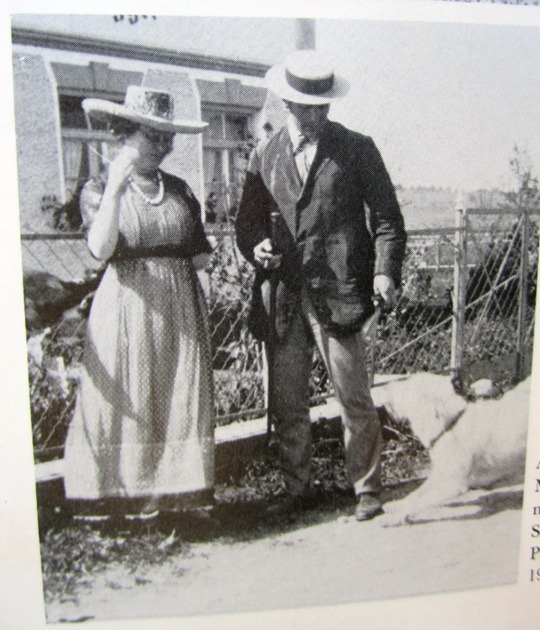
Well here it is, the long-awaited sequel to “Franz Marc Holding a Cell Phone.”
One of the things I like so much about Marc is that no matter how much you know about him, there is always something you don’t know, that, when you find out about it, is completely non-disappointing in terms of the fascinating blend of wackiness and gravity expected from Marc.
I especially like this photo because everyone — Maria Marc on the left and Russi Marc on the right — looks happy. Helmuth Macke was staying with the Marcs in 1911 so maybe he was the photographer. One for the road.
by Jean Marie Carey | 9 Aug 2011 | Animals, Animals in Art, Art History, Dogs!, Franz Marc, German Expressionism / Modernism, Stuff Found in Library Books
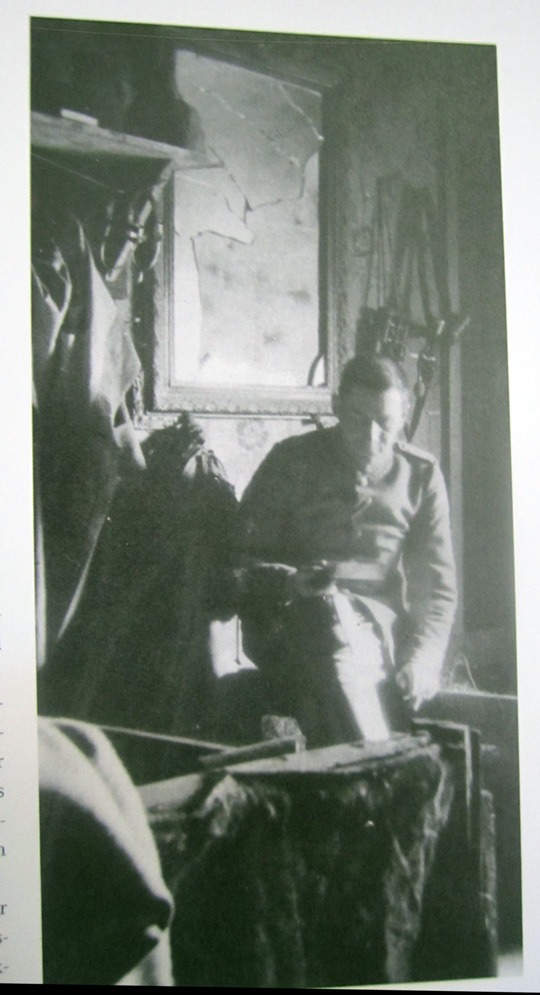
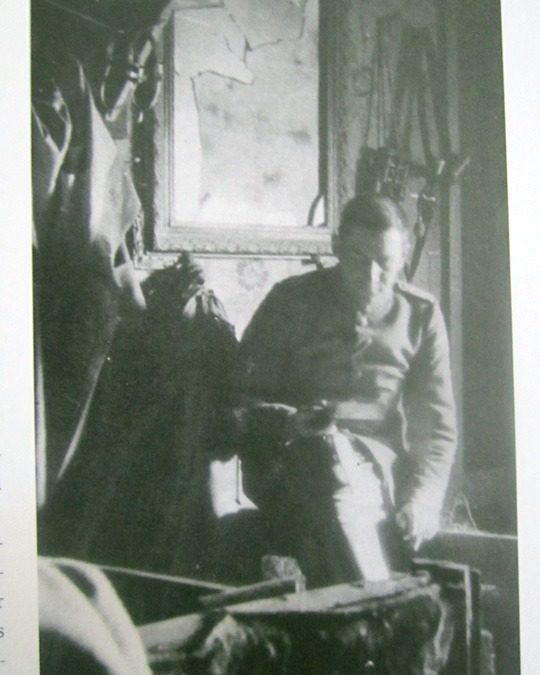
Franz Marc holding a cell phone, 1915.
Here is a mysterious photograph from Franz Marc – Paul Klee: ein Dialog in Bildern, a volume beautifully illustrated with the artists’ postcards to each other and some interesting photographs. Klee seems more vulnerable and less arch than you might expect in these letters and drawings. Marc, maybe predictably, sort of absorbs and reflects Klee; yet the images and texts on the cards seem both entwined and quotidian. One of the photos is this fascinating unsourced image, captioned “Franz Marc im Unterstand, 1915/1916.” It’s hard to tell what kind of shelter this is…it appears shell-shocked and comfortable at the same time. There are some binoculars and map cases hanging, and an eerie prophetic broken mirror. FM is smoking, of course, but the captivating question is what is he holding?
It looks like a cell phone, the kind you would expect FM to have, not a Blackberry or an iPhone, just a functional Nokia with Alpenlaendische Volksmusik ringtones. Photography professors, librarians, and two photo archivists who specialize in early 20th Century images looked at this photo and everyone was perplexed about the photo shows. That’s just how FM rolls.
What do you think this object is?
This book (which is confusingly cataloged with lots of commas instead of the conjunctions and articles that appear actually in print) forms the combined catalog from three retrospectives from 2010 at
the Franz Marc Museum in Kochel am See; the Stiftung Moritzburg (“Kunstmuseum des Landes Sachsen-Anhalt” in Halle, the craziest city in Flemish Brabant and the planet); and Zentrum Paul Klee in Bern.

by Jean Marie Carey | 25 Jul 2011 | Animals in Art, Art History, Franz Marc, German Expressionism / Modernism
“Dear Patron,
The item you requested: Von der Möglichkeit : das Phanomen der selbstschonferischen Möglichkeit in seinen kosmogonischen, mythisch-personifizierten und denkerisch-kunstlerischen Realisierungen als divergenztheologisches Problem
Dachfenster im Pinakothek der Moderne, München
is ready for you to checkout at the Tampa library’s Circulation Desk.”

by Jean Marie Carey | 30 May 2011 | Animals, Animals in Art, Art History, Franz Marc, German Expressionism / Modernism
I was fortunate recently to acquire a copy of Franz Marc, the 1936 biography by Alois J. Schardt. This is a cool book with a lot of drawings I had not seen before, including this study. This bat is a lot more cheerful than the one in Hoffnungslos. The echolocation abilities of bats were not identified until 1938 (but bats flew first, 53 million years ago, and then developed this type of sonar also used by dolphins and moles), so Marc wouldn’t have known about it. It is really cool to see that Marc realized how amazing bats are, though.

Anatomischestudien 1907 detail of bat, from Franz Marc

by Jean Marie Carey | 8 Feb 2011 | Animals, Animals in Art, Art History, Dogs!, Franz Marc, German Expressionism / Modernism, Italian Greyhounds, Stuff Found in Library Books
Fabeltier, Franz Marc, 1912
This is a really big week for birthdays: Bob Marley on 6 February (1945) [“it takes a revolution to make a solution”] and Saint Thomas More on 7 February (1478). More and more scholars agree ...the New Isle Called Utopia is a true socialist manifesto and I concur!
Most importantly though, 8 February (1880) is the birthday of painter, writer, animal sanctuarist, soldier, and millinery fashion icon Franz Marc.
Fabeltier (1912) is a plate from Der Blaue Reiter. Is the image a tiny (Italian Greyhound-looking) fanciful creature by a regular-size strawberry, or a giant strawberry with a little dog, or something else? I don’t know; it’s just fun and mysterious. Marc made a few illustrations like this called various iterations of Fabeltier but like gargoyles the animals resemble dogs, horses, lions…I especially like this one but they are all fantastic.

by Jean Marie Carey | 13 Jun 2010 | Art History, Franz Marc, German Expressionism / Modernism
Franz Marc’s best known writing is his public manifesto-ing, and also his correspondence with colleagues and family. But Marc also wrote on the covers of and inside his various sketchbooks all the time. This verse from around 1910 is really trippy in a Rimbaud sort of way. Some of the imagery and words come up again in paintings and painting titles. Thomas de Kayser, the editor of the volume in which this appears, organizes this material by theme very agreeably. Text in French follows the English translation.
Notes in the sketchbook XXVIII
— A pink rain fell over meadows.
— The air is like green glass.
— The girl [observed] looked into the water, the water was clear [as] crystal, the girl was crying.
— Trees had their growth rings, the animals their veins.
Notes in the sketchbook XXXI
The storm roared.
I entered the house and saw all
A tall woman red small black cat [playing] on the green table.
Kraak, lightning strikes the vehicle – the beautiful little cats were playing with the woman, she smiled – ah ah [poor] man and horse are [is] dead. [The man cries] [sky] the angel of fear knocks at the window; the [poor woman] I could shake the red heart of the woman and black kittens knew the green table – what it [?], red and black and green? Three colors give it a thought? If we give to the red heart shape, the black that [one of three interspersed] small kittens, green form of [a large square plate ?…] the square.
I meditate on that thought.
The red heart of the woman breaks.
It [comes] springs a [blood …] [a streak of blood] A stream of blood [across the sky due] which falls into the river, it flows through the now red green pastures grazed by sheep or black.
The storm has withdrawn his hand from the earth.
The blue sky [?] Ogle like a gigantic glass eye the scene [of] red, green, and black, this thought is not it terrible? […] Do you understand what the painters paint?
(more…)

 Well here it is, the long-awaited sequel to “Franz Marc Holding a Cell Phone.”