
by Jean Marie Carey | 30 May 2011 | Animals, Animals in Art, Art History, Franz Marc, German Expressionism / Modernism
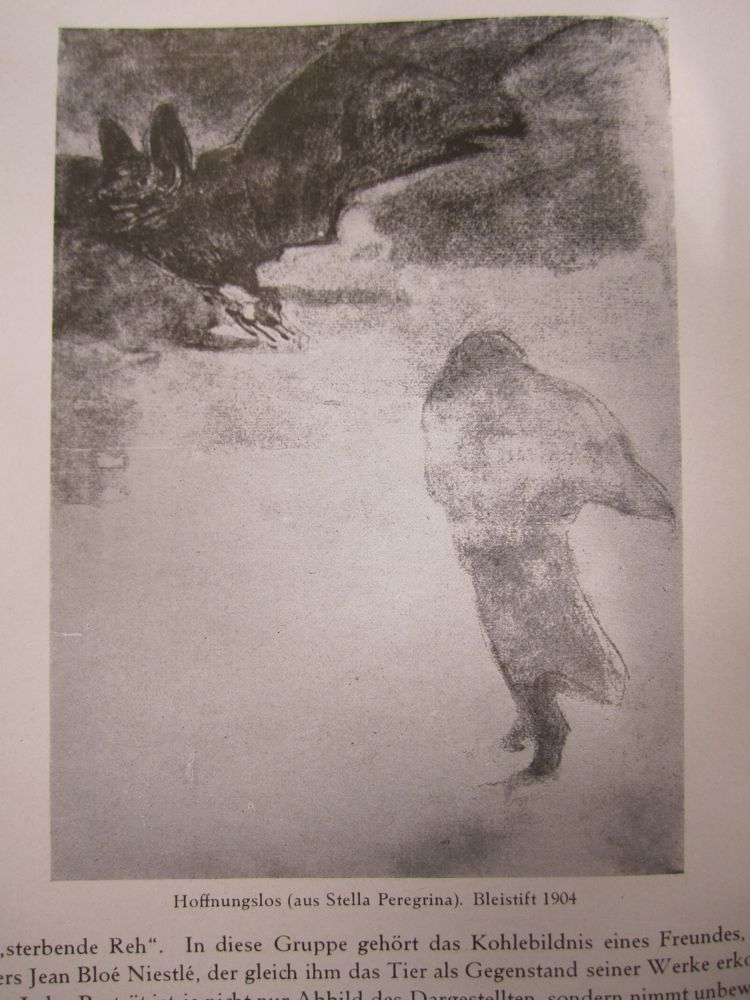
I was fortunate recently to acquire a copy of Franz Marc, the 1936 biography by Alois J. Schardt. This is a cool book with a lot of drawings I had not seen before, including this study. This bat is a lot more cheerful than the one in Hoffnungslos. The echolocation abilities of bats were not identified until 1938 (but bats flew first, 53 million years ago, and then developed this type of sonar also used by dolphins and moles), so Marc wouldn’t have known about it. It is really cool to see that Marc realized how amazing bats are, though.

Anatomischestudien 1907 detail of bat, from Franz Marc

by Jean Marie Carey | 6 May 2011 | Art History
People have been asking about the photo-documentation of the spectacular black eye and other bruises incurred in Bike Fall 2, so here are some images. One of the main purposes of this blog over the years has been to keep track of the various injuries of dogs and others, and I am cheerful to take my place alongside Marcie, Queequeg, and Astra (the Secretariat of accident-prone-ness). As bike accidents go, it was pretty bad, in that it happened so fast I couldn’t jump clear of the handlebars (or the pavement) and pretty good (I was wearing my helmet and didn’t get further run over by a car).
The most upsetting thing was when I went to inspect and clean up the bike. The sprockets, frame, wraps, seat, post, and tires are covered in sprays and drips of blood. I can’t believe I rode home. It was a good method research experience for being riding along one second and in exigent circumstances the next…
As bizarre sociological experiments go, the response to the black eye has been interesting. The power of denial is great, so a surprisingly large number of people — even those who see me pretty regularly and over a long period of time — just ignore the situation and act as if it is normal for an acquaintance to suddenly sport the rings of Saturn. A slight majority — probably 60 percent — evince some sort of reaction. People who have a more intense level of connection have more agitated responses. I guess this is what you would expect. One person who particularly loathes and despises me was quite effusive {“That looks like it must hurt a lot…you must be in a lot of pain!“}. Close friends and family have responded with an onslaught of soup, which is fantastic.

by Jean Marie Carey | 3 Apr 2011 | Animals, Animals in Art, Art History
Postcard to August Macke, 29 December 1910:
“Greetings to all, please give my best to your brother, and I respectfully commend your mother.”
by Jean Marie Carey | 20 Mar 2011 | Animals, Animals in Art, Art History
Franz Marc Hrsg. von Maria Marc, borrowed from The Clark in Williamstown, Massachusetts. This is pretty fantastic; the bat is carrying away a cow!

by Jean Marie Carey | 8 Feb 2011 | Animals, Animals in Art, Art History, Dogs!, Franz Marc, German Expressionism / Modernism, Italian Greyhounds, Stuff Found in Library Books
Fabeltier, Franz Marc, 1912
This is a really big week for birthdays: Bob Marley on 6 February (1945) [“it takes a revolution to make a solution”] and Saint Thomas More on 7 February (1478). More and more scholars agree ...the New Isle Called Utopia is a true socialist manifesto and I concur!
Most importantly though, 8 February (1880) is the birthday of painter, writer, animal sanctuarist, soldier, and millinery fashion icon Franz Marc.
Fabeltier (1912) is a plate from Der Blaue Reiter. Is the image a tiny (Italian Greyhound-looking) fanciful creature by a regular-size strawberry, or a giant strawberry with a little dog, or something else? I don’t know; it’s just fun and mysterious. Marc made a few illustrations like this called various iterations of Fabeltier but like gargoyles the animals resemble dogs, horses, lions…I especially like this one but they are all fantastic.
