by Jean Marie Carey | 25 Apr 2012 | Animals, Animals in Art, Dogs!, Music
Centurion is supposed to be historical fiction about the disappearance of the Legio IX Hispania in the third century in something like the Battle of Teutoberg Wald but it kind of lapses into … semi-fantasy. There is a lot of snow and awesome alpine scenery and fun costumes. Basically the only reason to see Centurion is for Dominic West in one of his typically movie-stealing supporting roles (as “General Titus Flavius Virilus” – really!) and Etain, the “guerra picta” played by Olga Kurylenko. Etain doesn’t speak, takes the wolf as her attribute animal, and endures a strange sort of Penthesilea-like death. She has fantastic Pict ordnance and body decorations.
I was sort of half-waking up, half-dreaming about the movie when the song “Signs” came on the former dataheaven.us I haven’t paid much attention to Bloc Party previously but I was blown away by this particular song. Maybe it was just the combination of sound and imagery but it really shook me up.
What do these two things have in common that together they should make such a resonant impression? I don’t know.
Here is the link to “Signs” on Soundcloud, and a snippet of lyric: “I could sleep forever these days because in my dreams I see you again.”

by Jean Marie Carey | 18 Mar 2012 | Animals, Animals in Art, Art History, Franz Marc, German Expressionism / Modernism

by Jean Marie Carey | 8 Feb 2012 | Animals, Animals in Art, Art History, Franz Marc, German Expressionism / Modernism
“I saw what the moorhen sees as it dives: the thousand rings that encircle each little life, the blue of the whispering sky swallowed by the lake, the enraptured moment of surfacing in another place. Know, my friends, what images are: the experience of surfacing in another place.”
{ Ich sah das Bild, das in den Augen des Teichhuhns sich bricht, wenn es untertaucht: die tausend Ringe, die jedes kleine Leben einfassen, das Blau der flüsternden Himmel, das der See trinkt, das verzückte Auftauchen an einem andern Ort, – erkennt, meine Freunde, was Bilder sind: das Auftauchen an einem anderen Ort. }
Franz Marc, Aphorismen 82, 1915.
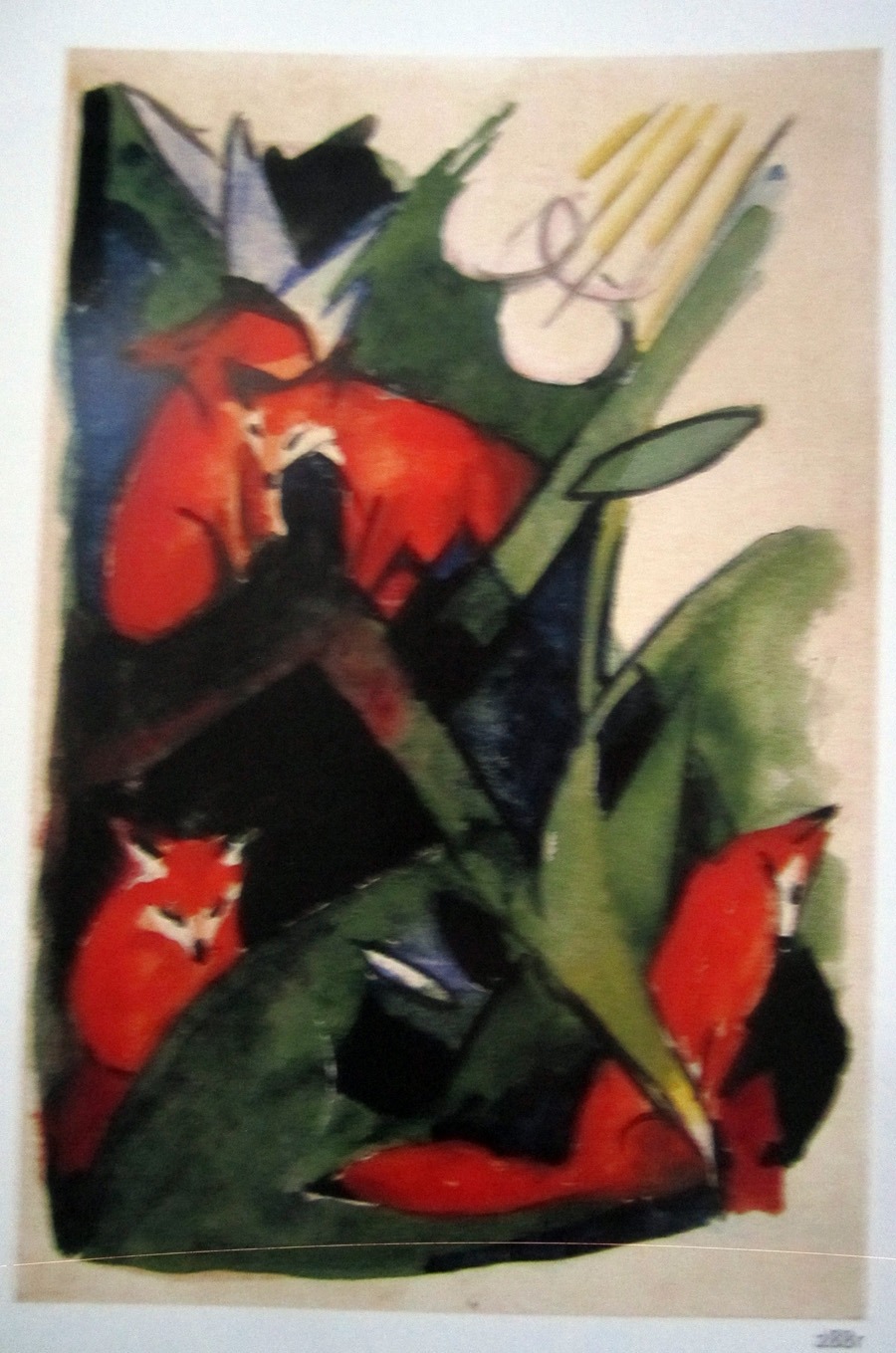
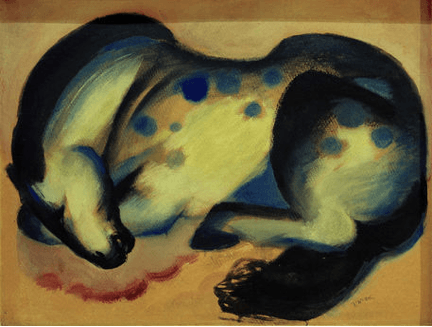
The images are Vier Füchse, a postcard from 1914, and Liegendes Pferd, a water color from 1911.

by Jean Marie Carey | 11 Dec 2011 | Art History, Stuff Found in Library Books
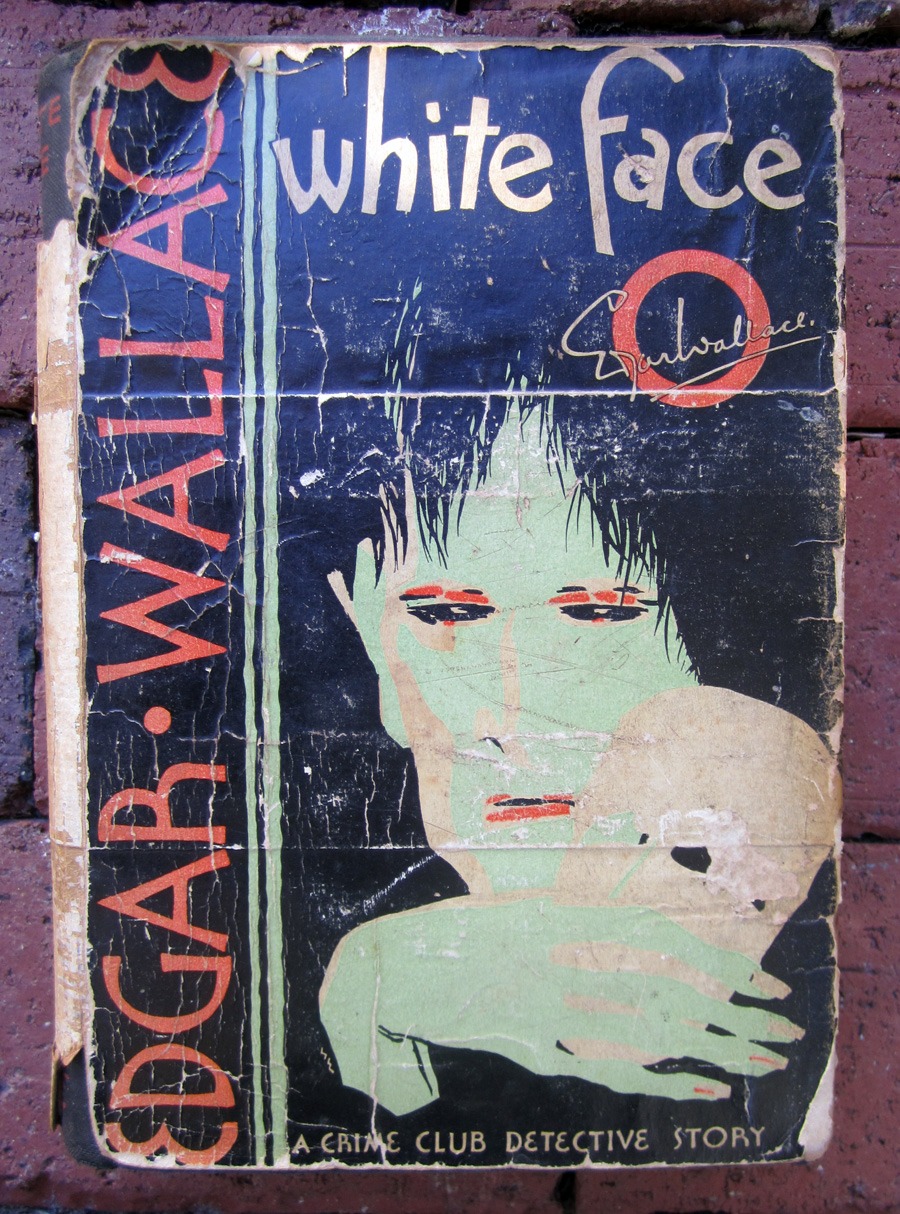

 Here are some more recent acquisitions from the rueful “Island of Misfit Books” project.
You probably know all about William Wordsworth, the English Romantic poet who was friends with Samuel Taylor Coleridge, with whom he visited Rheinland-Pfalz where they first got the idea to translate Goethe’s Faustus.
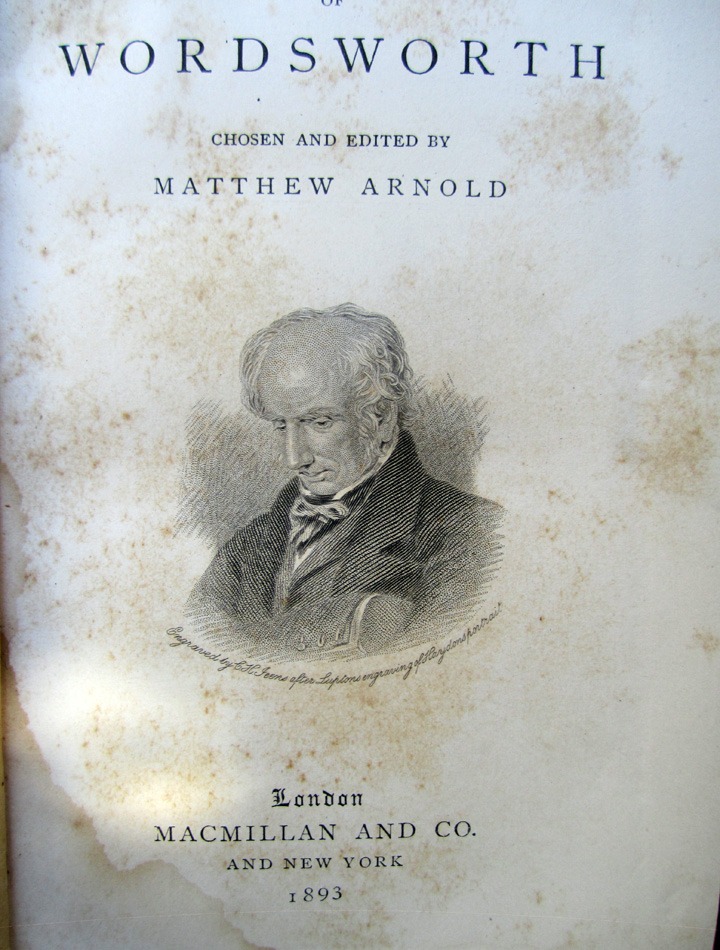
This volume is called Poems of Wordsworth Chosen and edited by Matthew Arnold. Arnold was an English professor (at Rugby and then Oxford) who was also a poet; “Dover Beach” is often referenced by Ian McEwan and appears in Fahrenheit 451. This book is a printing from 1893. The spine is very bent and there are fingerprints and some faint traces of pencil on almost every page…someone really liked this book.
Crime novelist and short story writer Edgar Wallace was also quite a character and became, in 1927, one of the first authors to secure a deal with a movie studio for stories and scripts. This turned out to be a good thing because Wallace was also, earlier, the creator of King Kong. (In the scene in the basement tavern in Inglourious Basterds during the “Who Am I?” game there are references to both King Kong and Wallace.) As you can see by the cover of White Face, Wallace was also academically ahead of his time, having devoted several hundred pages lo in 1930 to the exploration of the astonishing theory that, indeed, some segment of the population — perhaps even you — is in fact white. A film was made of White Face as well; it premiered in March 1932, just a few weeks after Wallace’s death in February of the same year.
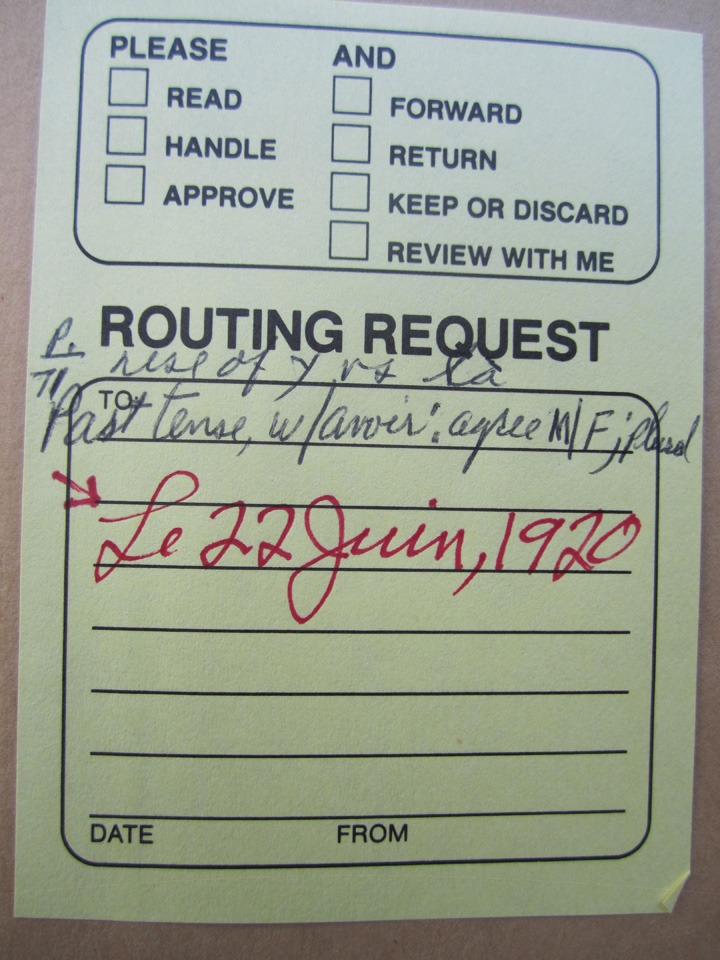
Speaking of trends in scholarship, of course it is no longer necessary to speak French or go to France in order to become a person of letters on French subjects. Nonthetless, my favorite book in this trio is the Brief French Grammar. It was the property of a the New York Public Library in the second decade of the 1900s, and then of the Board of Education of the City of New York where it circulated until 1936. A very enthusiastic student marked a routing slip left inside the book with an emphatic red date: Le Juin 22, 1920. Completely adorable.

by Jean Marie Carey | 2 Dec 2011 | Animals in Art, Art History, Dogs!, Franz Marc, German Expressionism / Modernism
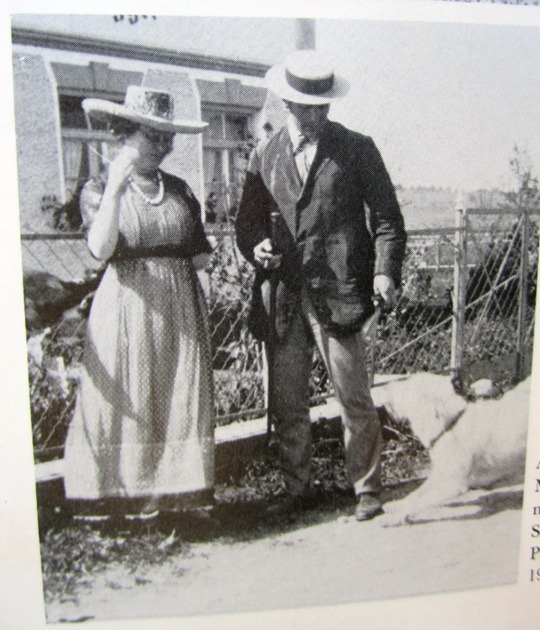
Well here it is, the long-awaited sequel to “Franz Marc Holding a Cell Phone.”
One of the things I like so much about Marc is that no matter how much you know about him, there is always something you don’t know, that, when you find out about it, is completely non-disappointing in terms of the fascinating blend of wackiness and gravity expected from Marc.
I especially like this photo because everyone — Maria Marc on the left and Russi Marc on the right — looks happy. Helmuth Macke was staying with the Marcs in 1911 so maybe he was the photographer. One for the road.