by Jean Marie Carey | 23 May 2013 | Dogs!, Italian Greyhounds, LÖL, MVV / MVG Hunde von München
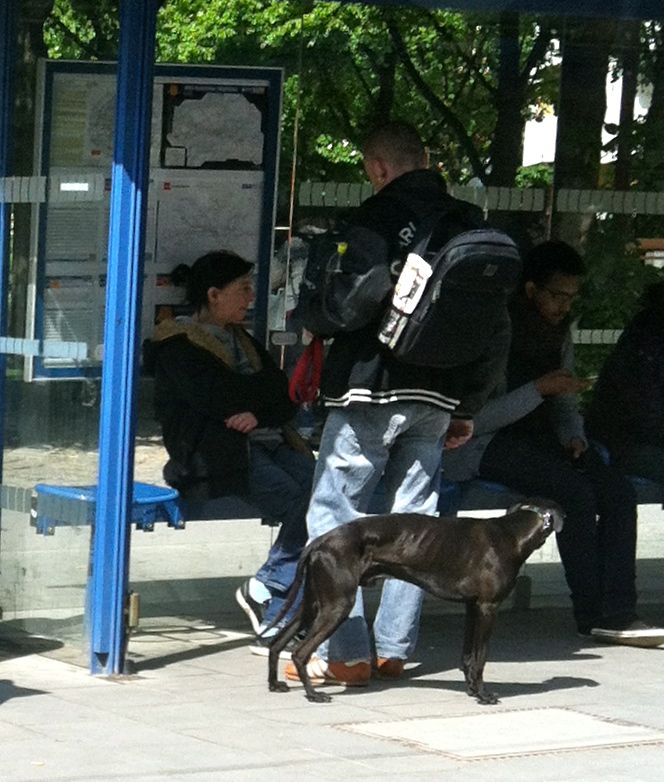
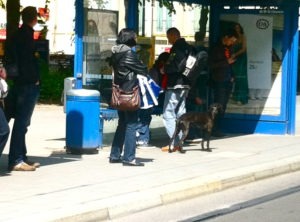
It’s been a little while and in fact there is a backlog of photos in waiting. This amazing creature cannot wait though, so here he is. Black whippets are rare, and a self-colored black whippet rarer still. I know there are more self-colored sighthounds in the EU than the US, but I haven’t seen any, probably because it is too cold for them to come out. This dark-haired hound was almost glowing in the rare patch of sunlight…I was already on the tram and the dog was waiting for the tram on the other side of the street, and when I got off at the next stop and walked back was already gone. I hope I see him again!
12:28 23 May 2013, Hohenzollernplatz, Trams 12 & 27, Metrobus 53.
by Jean Marie Carey | 20 May 2013 | Art History, German Expressionism / Modernism, LÖL, Re-Enactments© and MashUps
Should We Go In?
I have followed Kunstraum München for some time and now that I’m here have been eager to investigate, a plan somewhat impeded by the Verein’s tendency to announce events through the city (which supports the venue/group for contemporary art and criticism – its 40th anniversary is this year) i.e. a bit slowly, and sporadically through a social media platform owned by someone with the initials MZ I do not often participate in (more on social media at the end), and also since I am often busy on the Wednesdays when meetings and lectures take place.
In any case being free on Pfingstenmontag allowed a friend visiting from Brussels and I to haunt tonight’s talk „Warum im Kollektiv?“ by members of Hamburg’s 8. Salon. Visually this also served as a near-to-closing reception for the Mahlergruppe Austellung Of Two Minds (the actual end date is 26 May). You can see some Mahlergruppe work on its low-key Website. The emphasis on group (founded in 2008 at Munich’s Akademie der Bildenden Künste) and the lack of artists’ statements and biographies is very refreshing, and the powerful graphite-and-acrylic bilder – somewhere between drawings and paintings, are, to me distinctively Munchneresque.
Of Two Minds also includes a sculpture, Bellestar, a craft of formed and draped corrugated framing, and a few photographs of Zurich’s “Needle Park,” circa the 1980s and 1990s at the beginning and then height of needle-borne infection. Of Two Minds isn’t a conceptually straightforward rumination on dystopia, though. Perhaps as the name implies it asks about how we remember these types of weirdly hermetic thought/images that may or may not be indexical. (Of course for Americans the first thing that comes to mind is Al Pacino’s laconic junkie in Panic in Needle Park, the film school staple from 1971.) Thinking about how much Zurich has changed in the past decades doesn’t diminish these images which aren’t exactly memories, though they do form the strong impression of something personally experienced (another film analogy would be the impression of Marseille and Brest from The French Connection and Querelle, though the French coastal cities haven’t been like that in … forever, and were already “not like that” when Genet was writing and Fassbinder and Friedkin were filming).
(more…)
by Jean Marie Carey | 15 May 2013 | Animals, Animals in Art, Re-Enactments© and MashUps
Somewhere embedded on the candlestick chart of historic tragedies, between, say, the Armenian Genocide and the Andrea Doria, is this: receiving an email from the responder ceviche.com.
Waking up to this missive brought me back to the day when I had a John S. Knight Journalism Fellowship for coverage of animal and environmental issues…now I realize that this is not the same occupational caliber of the Fourth Estate, as, for example, writing about visiting the homes of the wealthy and repeatedly giving shouts-out to one’s friends in the pages of a free weekly shopper magazine, but, still.
In any case one of the stories I wrote back in the day was about the infestation by roaches of some of Atlanta’s downtown landmarks. One of the things I learned was about roach housing, or harborage, in (for another example) restaurants housed in older structures amid a fairly high building density adjacent to bodies of water and a connected estuarial sewer system (this probably does not resonate at all!) was that, because the static population of roaches is always relatively high and self-managing through nice roach habits like juvenile cannibalism, and is also largely nocturnal, something really extraordinary has to happen in order for roaches to come out and be seen during the day (like, say, in a bustling bright loud kitchen during a health inspection?), there have to be so many roaches, such an explosion of the roach population, that, basically, they have to come out and forage to prevent from starving (and as you probably also know roaches can go a good while without eating).
So in such a situation, in addition to the stray visible roaches, we are talking about an infestation of, like, millions of roaches. If you took the lid off the nearest manhole cover and shot a leaf blower into it, the sky would turn black with flying roaches… So, that. PR might be able to spin the Benghazi situation, but all the consulting in the world can’t make millions of roaches go away. Except for the gullible in-crowd wannabes, who, in an obverse of the Emperor’s New Clothes, will simply will themselves into not seeing or thinking about them. The roaches, I mean… For a breakdown of roach-related health issues, please see this totally legit publication from the World Health Organization.
(more…)
by Jean Marie Carey | 12 May 2013 | Art History, German Expressionism / Modernism
There’s a moment when the super-creative but detached suddenly open up and reveal actually, they do know what’s going on. It’s a brave thing to do because it both raises the stakes for intellectual performance and blows away the dandelion dander of the potentially naive. Maybe partly involuntarily but resolutely nonetheless, Liam Gillick’s two works arranged in careful complement in the subterranean Lenbachhaus annex achieve this emergence, perhaps more substantively than at their dates of creation in the ‘aughts.
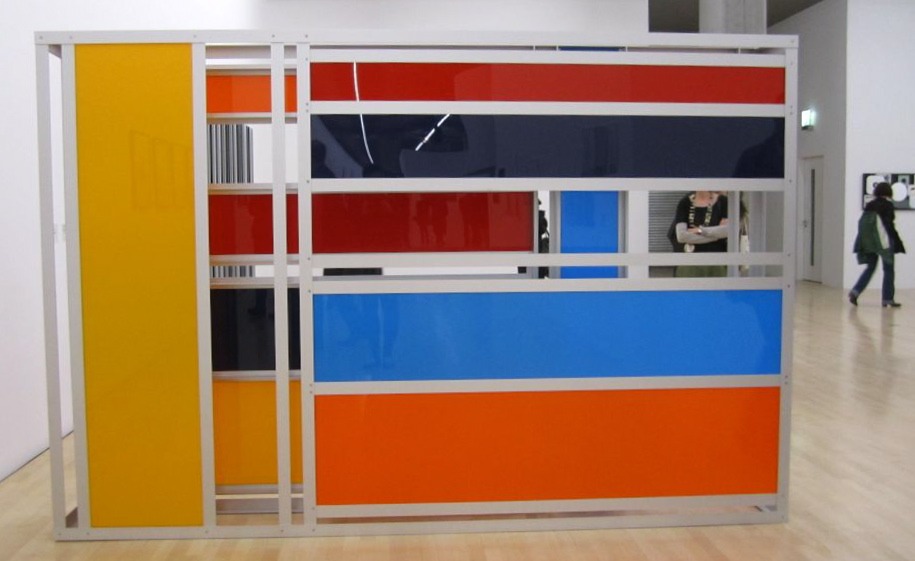
Part of the KiCo Stiftung comprising the very deep “Kunst nach 1945” Sammlung, Gillick’s Screened Reduction (2001) and Glanced in the Midst of a Legislative Break (2006) are opaque Plexiglas and aluminum structures, sculptures poised at the edge of painting. In reference to the latter they clearly hearken to Kenneth Noland’s high Straight Edge (think Bridge circa 1964) and are also thematically in sync with an earlier guest in the Kunstbau, Piet Mondrian, and as such more than nod to the historical commitment to abstraction.
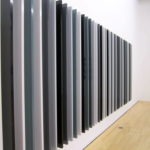
Gillick, who is also a composer and musician (he actually made the sampling loop of the Smiths’ How Soon is Now? you will remember – if you are a former club kid – from Soho’s 1990 nightclub single Hippy Chick!), tends to characterize his work in careful Global Art Fair-speak as being about the questioning of political authority and so on. However taking at visual and bodily encounter value, Screened Reduction and Glanced in the Midst of a Legislative Break are hardly obscurantist, inviting inspection and delectation in simple optics.
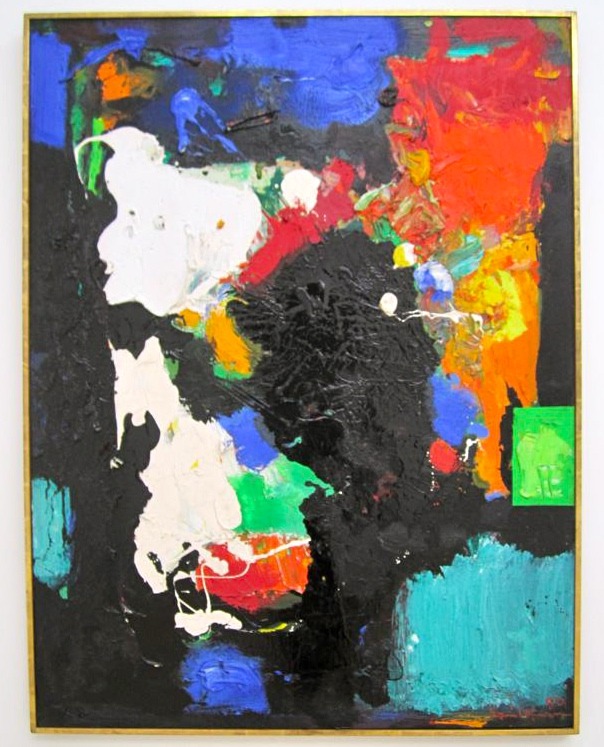
I decided to take this sort of sideways approach to writing about “Das Neue Lenbachhaus” when on a subsequent visit I saw for the first time, for a long time, and up very close, Hans Hoffman’s The Conjurer (1959). Hoffman is very collected but quite under-studied, and this painting is historically significant as well as quite lovely. I hope you can see in the adjacent image the toned translucency and balance of the aqua swatch, which is so carefully balanced on the canvas that the bright color does not preoccupy the eye, and also the charcoal impasto and general texture of the canvas, which is both thick and lustrous.
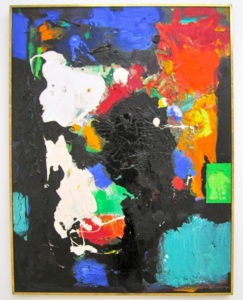
The Bavarian-born Hoffman traveled back and forth between Munich and the United States, and like Kandinsky once opened his own school for artists. Hoffman had many talented students, including Louise Nevelson, Allan Kaprow and Helen Frankenthaler. The Conjurer, made some years after Frankenthaler became well-known for her vertical soak-stain paintings, suggests maybe Hoffman, like Morris Louis, got some ideas from Frankenthaler, too.
by Jean Marie Carey | 24 Apr 2013 | Art History, Music, Re-Enactments© and MashUps
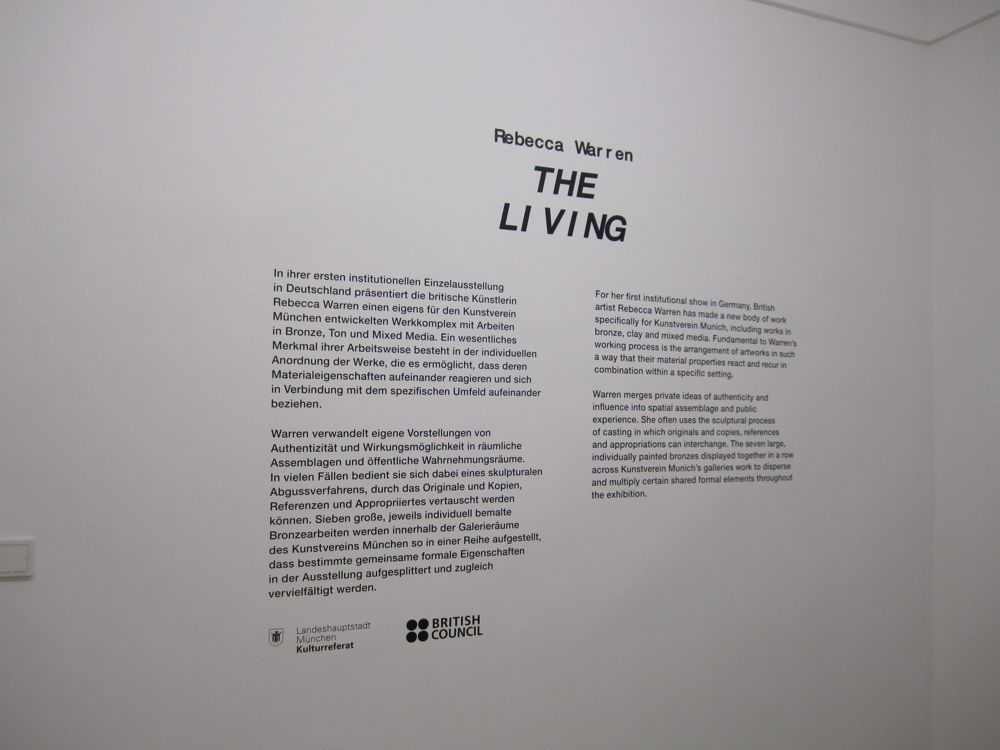
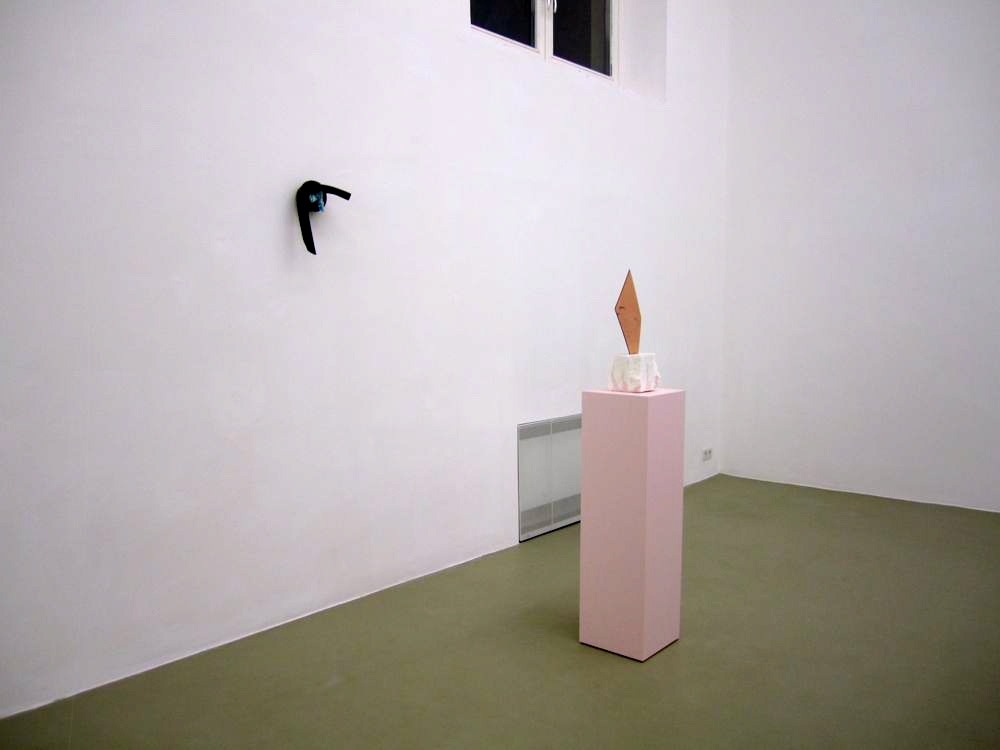
The opening for Rebecca Warren’s installation at Kunstverein München on 19 April 2013 was dramatically heightened by a rain so steady and soft it enveloped more like fog. To be clear it’s just me who is describing Warren’s experiment in biomorphic austerity as an installation; you can read more about the British artist’s commission for the Kunstverein here if you do not mind the maddening floating text. One of the good things about the script for this exhibit is actually that it does not try to overexplain the sculptor’s intentions, a la the surfeit of “instructions” that seem to come with other conceptual sculptural works such as those by Teresita Fernández.
The main space is occupied by a columnar arrangement of tall cast bronze totems, embellished with female-ish parts, regularly spaced but not wholly viewable at a take. To me this suggested a course of weave poles like those on agility courses for dogs, so that was my “phenomenological” approach. The objects above were set above and in an alcove; overall, especially at night, an effective use of the placement of the Kunstverein building’s windows.
All vastly oversimplified, of course.
An “afterparty” in the foyer featured a fantastic set by Berlin-based turntable-techno-transformative-sounds collective M.E.S.H. that almost enticed some reactive dancing.