
by Jean Marie Carey | 13 Sep 2013 | Animals in Art, Franz Marc, Stuff Found in Library Books
When I was little I was lucky to find my way very young to The Black Stallion books by Walter Farley. I read every single book (they appeared every other year or so from 1941 to 1983; the original book was made by into a stunning film of the same name) many times and like the Jim Kjelgaard dog books (Snow Dog, Big Red) I still read them once in a while. As a child I had Breyer horses and Barkies dogs and the scale of the models was compatible enough that I created an early kind of fan fiction diorama series in which the dogs from the Kjelgaard books met the horses from the Farley books.
Of the horses, I actually preferred The Island Stallion, Flame, and Black Minx, the Black’s (Shêtân) daughter. Also some of the “supporting” horse characters, particularly Wintertime and Sunraider. Of course Eclipse and the Piebald were fantastic villains. Unlike Kjelgaard, who told his stories from the perspective of the animals alone, Farley mixed the narratives voices between humans and horses mostly to good effect. Generally both these series of books are underrated and understudied; they are every bit as elegant and meaningful as Call of the Wild without the violence and free from the burden of having to explain the stereotypes of the time; so they remain free for children to enjoy today.
I was thinking about the Black Minx on and off for the past few weeks and even had a dream about the race with Eclipse that is the set piece of The Black Stallion’s Courage.
The Black Minx and Eclipse… Black Minx is the one horse whose speed potential we never really learn. Only “the boy”, Alec Ramsay, can inspire obedience in the headstrong filly. She was a poky frontrunner…she would get out in front of the other horses in every race, put lengths and lengths of distance between herself and the pack, and then…begin daydreaming until she wandered across the finish, albeit still the winner. She is also a bit romantic in other ways, falling in love with her colt rival Wintertime (who like Flame is a solid chestnut) and always wanting to play around with the other horses and guide ponies. Alec decides to “make” Black Minx more competitive by running her with Eclipse (who is dark bay), the wonder colt she bests in the Kentucky Derby but who rapidly thereafter matures into both a magnificent athlete and a terror, speedier (for a spell) even than the Black and cruel, toying with and breaking the spirits of his rivals.
But this plan backfires. The Black Minx bitterly resents having her dedication tested and the forced competition with Eclipse, whom she loathes. She never trusts Alec again. Moreover in these trials she is faster; Black Minx knows all along that even though Eclipse is very fast, she is too far ahead – all she has to do is hold her lead, which she does. Eclipse is bitter about Black Minx’s ease. Finally, in the Belmont Stakes, when all the horses (except the Black) race, Black Minx protests. Wintertime can’t keep the pace Black Minx and Eclipse set, so Black Minx simply slows down and keeps pace with Wintertime. Eclipse surges across the finish line breaking a track and world record. But as Alec races to Black Minx to make sure everything is OK, Eclipse realizes that Alec loved her best no matter what, win or lose. So for Alec and Eclipse, this is a sad story in terms of people-horse relations. For Black Minx, following her refusal to compete, she is retired, as is Wintertime, and they spend the rest of their days together. (In the very last books of the series, Wintertime and Black Minx have a daughter who is also unruly, Black Pepper.)
Tim Farley, Walter Farley’s son, maintains a Black Stallion Website that has a very fun forum, a lot of beautiful images of horses, naturally, stills and clips from the movies, and a real treasure – the vintage covers from the first editions of each of the books.
by Jean Marie Carey | 1 Sep 2013 | Animals, Animals in Art, Art History, Franz Marc, German Expressionism / Modernism
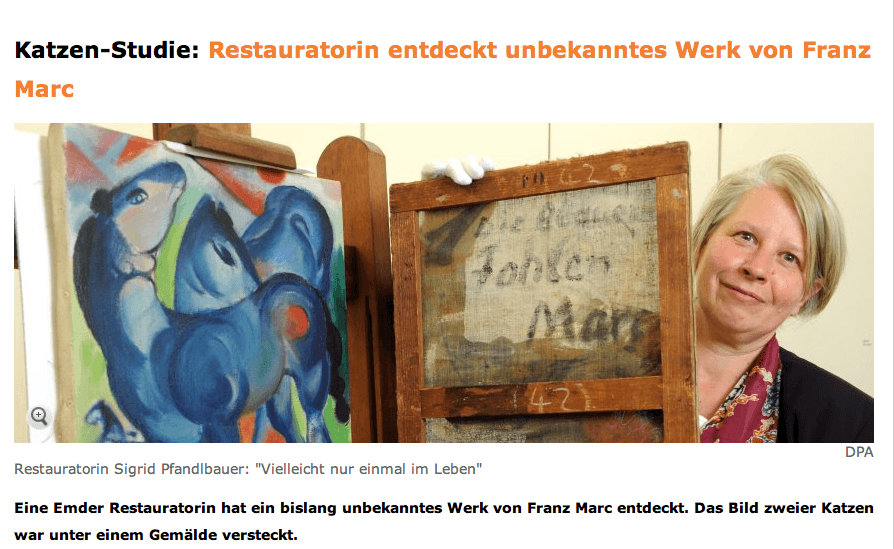
Der Spiegel online had a story today about an art restorer’s amazing discovery of a new Franz Marc painting on the reverse of 1913’s Blauen Fohlen. Sigrid Pfandlbauer of the Kunsthalle Emden found the study of two cats bearing Marc’s signature while restoring Blauen Fohlen for an upcoming exhibition. What an incredible, exciting discovery…how much there is still to be learned about Marc.

by Jean Marie Carey | 20 Aug 2013 | Art History, Franz Marc, German Expressionism / Modernism, LÖL
Postkarte am Bubi, Franz Marc and Auguste Macke, 1911. This looks like mostly AM really. I love the way the feathers become the fish…
“We actually had many more exciting exchanges back-and-forth, most of which were very unproductive and very unbecoming of two grown men.” LÖL.

by Jean Marie Carey | 15 Aug 2013 | Animals, Animals in Art, Art History, Re-Enactments© and MashUps
This post was actually written quite some time ago and held in reserve with about 50 other little stories under the title “Grendel’s Mother Doesn’t Have a Name!” which is now the title of a book chapter. It is actually only a little confusing, and also my devotion to pinnipeds remains unswerving.
I was inspired to revisit by sequential experiences, the first running across an adorable video of a sea otter playing a sort of tag with an Australian cattle dog. The sea otter is clearly enjoying himself, and as I watched him woof softly as he partially clambered up onto a dock, I heard myself think “…er lacht…” followed by a moment of confusion and then thinking… “… was ist das auf Englisch?” For a second I couldn’t think of the words. I have had a few fragmentary dreams in German, but this is the first time anything like this has ever happened in regular life. It was actually very pleasant and I hope it will begin to happen more often.
The other addition to this post is this image of this astounding statue watching over Hohenzollernplatz. It was made by Ferdinand Liebermann in 1930 and has withstood a lot. This is a very evocative image naturally and also reminds me of the moschophoros, which in turn puts me in mind of Knabe Mit Lamm and the poor unfortunate kids…(just a tiny image here because a whole story is coming along about this painting).

by Jean Marie Carey | 23 Jul 2013 | Art History, German Expressionism / Modernism
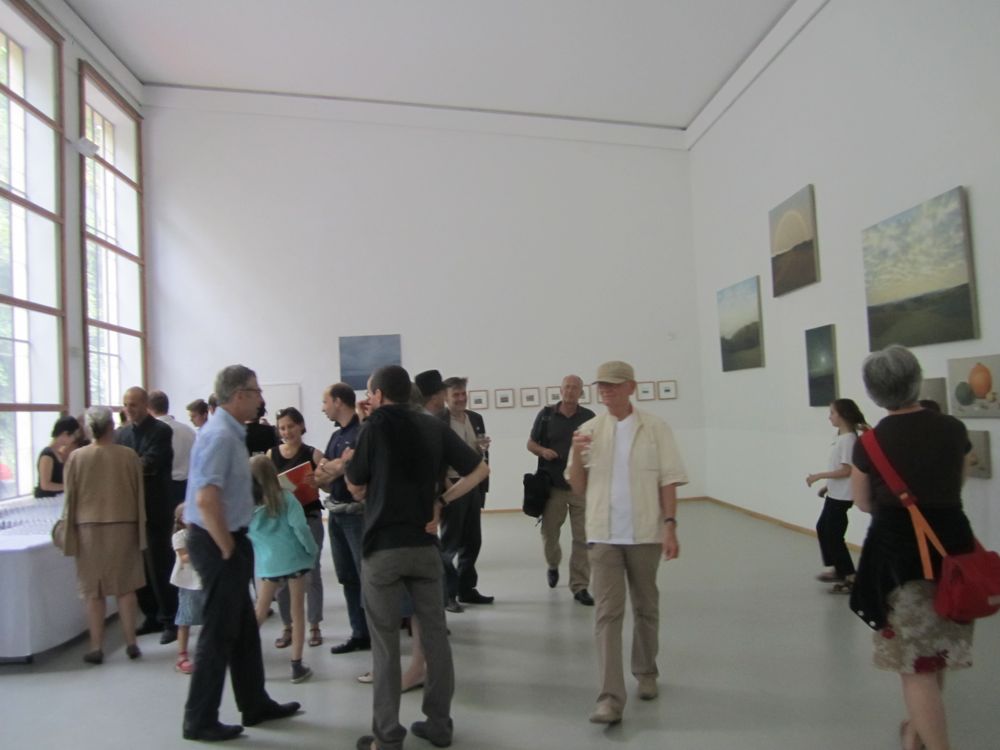
Danaé Xynias’s “Weite Fluren” is a good match for the Orangerie.
In framing the composition of a landscape painting, the challenge to the image maker, following eons of tradition, comes down fundamentally to where to place the horizon line. Contemporary painters have toyed with this problem experimentally, such as in Colin McCahon’s various large-panel installations of volcanic vistas in New Zealand. At the far reaches of these modern manifestations falls Trevor Paglen’s Covert Operations and Classified Landscapes (2010) presenting the horizon as, also, metaphorically unreachable. To sort of put things back into perspective, so to speak, Danaé Xynias makes the brave choice to return to the subject of landscape painting – the meeting of land (or water) and sky – allowing the horizon line to settle for the most part naturally in the center of her canvases.
Xynias’s current exhibition, “Weite Fluren,” is a mixture of landscapes and stylized still-lifes. (The still-lifes are certainly interesting in their own right, with rounded forms of pumpkins and melons against a zero-depth background intensifying the relationship between subject and frame.)
A reference in the catalog for the show marks an oblique historical lineage by referencing both Caspar David Friedrich and Jacob van Ruisdael, demurring that Xynias doesn’t quote them directly. This is true, though particularly the low clouds often associated with the van Ruisdael family are a clear evocation of the past. Make no mistake though Xynias is strictly a modernist, in the sense that her facture is very clean, the painted surface entirely flat and removed from the content in careful application. The space Xynias makes reference to in the exhibition title is obviously something that is of keen interest in its totality to the painter, a graduate of the Kunstakademie Düsseldorf who practices in a remote studio in Niederbayern. “Weite Fluren” is luminous in its incarnation at the Orangerie in the Englischer Garten, the classicizing space with the summer-lush exterior always at the peripheral always in view. The show is hung simply, without name markers as a distraction, with the larger landscapes singly or in groups slightly above eye-level, making visitors have to look “up” into the skies of the paintings.
