by Jean Marie Carey | 25 Apr 2017 | Re-Enactments© and MashUps
Kaffeebohne
Over the Easter weekend I went on several hikes with my friends Wiebke and Luisa, which during the winter involved getting lost and crossing the partially iced-over Fulda. These walks were not as perilous though there was some Osternausflippen on the tiny Cantus train over the frequently-contentious issue of bike transport, which I mostly attribute to the seeming interminability of the religious holiday to the non-religious Hessians.
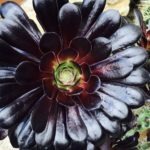
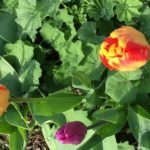
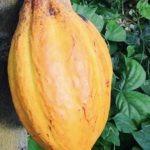
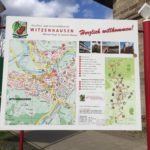
On Sunday we traveled to the Universität Kassel’s Witzenhausen campus to visit the Gewächshaus für tropische Nutzpflanzen, a huge greenhouse complex of tropical plants like coffee and giant grapefruit. Stadt Witzenhausen, “die Kirschenstadt,” itself is the “legendary” home to many cherry trees, though I have never seen many Kirschblüte in the two springs I have been here – maybe that’s the Witz.
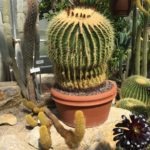
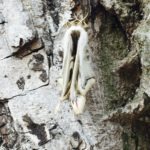
Farther down the River Werra, where the river turns back into the Fulda, is the Botanischer Garten Kassel, where we saw a moth and butterfly incubation house, with thousands of Tagpfauenauge (a true Schmetterlinge species, not a moth as they appear), just coming out of their cocoons. Also a special humidity controlled greenhouse just for cacti.
by Jean Marie Carey | 7 Apr 2017 | Art History, Dogs!, Franz Marc, German Expressionism / Modernism, Re-Enactments© and MashUps
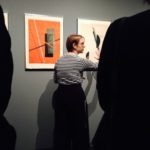
Ars Graphica is a group of mostly European scholars who study prints but also photography. The pan-European organization also has a few Gesamtstaaten. Ars Graphica Deutschland recently branched off and began its own activities. The first one was this week, a tour of the In die Dritte Dimension: Raumkonzepte auf Papier vom Bauhaus bis our Gegenwart exhibition at the Städel Museum in Frankfurt given by the curator, Jenny Glaser. You can read more about what transpired here.
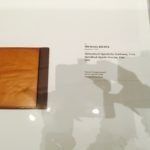
Dr. Glaser has organized a really superb show. The low and direct lighting is a bit off-putting at first, but many of the works are cut-outs, collages, incisions, or have subtleties of depth that the creation of shadows augments. The El Lissitzky poster prints from the Bauhaus are the stars of the show and Glaser’s clear favorite, but the less-known miniatures (matchbox sized) by Blinky Palermo placed across from Sol LeWitt’s late (2001) colorful confetti collage are probably more interesting, as is Michael Riedel’s artist book of minute but deep surgical removals.
There was also a look at the Städel’s more traditional Renaissance and Early Modern prints, and we got to visit and share a bit about our research…of course I have a vested interest in something at the Städel that is not a print…
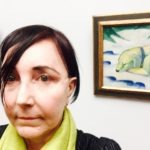
I thought it might be best to just tell the exciting but short story about Liegender Hund im Schnee‘s journey from the Franz Marc estate to entartete to West Palm Beach and back to the Städel. Somehow the actual Germans were able to refrain from exclaiming that “all Germans are Nazis so who really cares if the museum was looted?”*
*Actual crowd responses at two of my last talks. More on this, as I keep promising, shortly; I actually have quite a lot to say about this in reference to the College Art Association in particular and looting apologists in general.