
by Jean Marie Carey | 18 Feb 2016 | Animals, Animals in Art, Dogs!, Franz Marc, German Expressionism / Modernism, LÖL
During February and March I am a Wissenschaftliche Gäste of sorts at the Universität Kassel’s Tier-Mensch Gesellschaft. I’m doing some research in the dOCUMENTA Archiv, finishing up a chapter in my dissertation, and giving a talk at this first-of-its-kind conference, “Animal Biographies: Recovering Animal Selfhood through Interdisciplinary Narration?”.
The program is incredible and the speakers amazing, each talk as fascinating as the next. There are also several installations and exhibits by Mathias Antlfinger and Ute Hörner and the interspecies collective from CMUK Köln. The program is free and you can register through 25 February through the link above.
I don’t know if I can quite live up to the talents of the other panelists, but I am confident of the attraction, pathos, and intrigue of my animal biographic subject, Russi Marc, whose death exactly 100 years ago this week was noted by his lifelong human companion, Franz Marc, who made many drawings and paintings of Russi through their lives together. Franz Marc himself died just a few weeks later. Studying Russi has taken on a life of its own in my research, and as this was a very well-documented dog and one who had many humorous and thrilling adventures I am very excited to be able to share his story with other animal lovers.
One thing I like so much about animal studies (in discussing the title of our nascent discipline, which is now beginning something like its second wave most of us are happy to jettison the “human-” prefix) is that its adherents are for the most part partisan activists. This challenge to the academy as we fight the losing battle of the Anthropocene and the Sixth Mass Extinction has not gone unnoticed; this week, a sort of prank article was exposed (and one could extrapolate perhaps planted by the same people or person), in the December 2015 issue of the academic journal Totalitarismus und Demokratie. In retrospect, perhaps a “discovery” about the inherited aggression of “German” German Shepherds was too good to be true…but I am very curious to see what the fallout will be, since the “research” depended upon “primary sources” about dogs…another reason to be glad for Russi’s well-established canine celebritude, I guess.

by Jean Marie Carey | 12 Feb 2016 | Animals, Animals in Art, Art History, Franz Marc
Franz Marc, Zwei Katzen, blau und gelb, 1912
The College Art Association conference was held 3-6 February in Washington, D.C., which for what I study is not a very interesting art city in the way New York City is…and D.C. is thus also very expensive to visit, since the trip doesn’t include a few precious hours in the Met, MoMA, Guggenheim, Neue Galerie, and so on.
If conferencing, not museum-visiting, is to be CAA’s focus going forward, the organization should do what the German Studies Association does, and move the meeting to some less-costly destinations that still have good mass transit and more of a range of hotel rooms, like Las Vegas or Atlanta.
This conference I had a lot of tasks I actually had to do, and one I wanted to do, or I should say was very curious about doing, attending the Historians of German, Scandinavian and Central European Art, or HGSCEA, [formerly just HGCEA, but, I guess the Munch people or something…] meeting, which this year took the form of a dinner honoring the long-reigning and undisputed chief Kandinsky scholar, Rose Carol Washton Long of the Graduate Center of the City University of New York, and Charles Haxthausen from Williams College.
I took the cryptic “honoring” on the invitation to mean “retiring,” which put me in mind of The King of the Cats. Miss Jessel’s “Haunted Palace” blog gives a nice account of the oral history tradition of this tale and its place in the folklore of the British Isles but, basically, without belaboring the point the outstanding extra-narrative moral for cat lovers and observers is probably that upon learning of the death of “the king of the cats,” all cats think that they are the designated heir to the throne.
So with respect to the fractious group of people who comprise known Kandinsky scholars…without an obvious heir apparent (to my mind there is not one, the once-promising regent having chosen their battles poorly), wouldn’t they all be prepared for anointment? As it turned out RCWL, in her very congenial speech, immediately made clear that while she was retiring from CUNY, she would not be relinquishing the reins to the Kandinsky dynasty anytime soon.
 The “party” itself was quite a mysterious affair in that it did not appear as an “affiliated society” event anywhere on the CAA schedule (or the new Linked-In developer-sponsored) app, and was held in a small restaurant in Adams Morgan which was entirely closed except for the HSGCEA dinner. RSVP, affiliation, and credentials were thoroughly vetted at the door, and there were no nametags. Nametags would not have been much use anyway, since everyone went by a non-apparent nickname, like “Ricki” or “Mark.” And it was very dark inside the restaurant, Lillie’s (actual lighting shown), and you couldn’t see even across the room. So in other words it was pretty much how I expected it to be, except there wasn’t any kind of St. Bartholomew’s day type of fracas, duel, or mass feline exit through the fireplace.
As to my own paper and panel, I was thrown off my presentating game a little – not a lot, or not as much as I had expected or was undoubtedly intended – and got a lot of good questions, including some very specific queries from some more-than-casual idolators about Animalisierung, of all things, about the painting Tierschicksale, and about what I had specifically set out to talk about, affect/effect disturbing/calming animal images have upon human animal/human-animal empathy.
Basically my claim is that disapprobation toward animal abusers – such as generated by the film The Cove and the work of Sue Coe – is not as strong a motivator as true identification with the animal subject. Hence the focus on Franz Marc. This isn’t necessarily as obvious an idea as it seems, and bears more discussion and exploration (which is why I am writing about it).

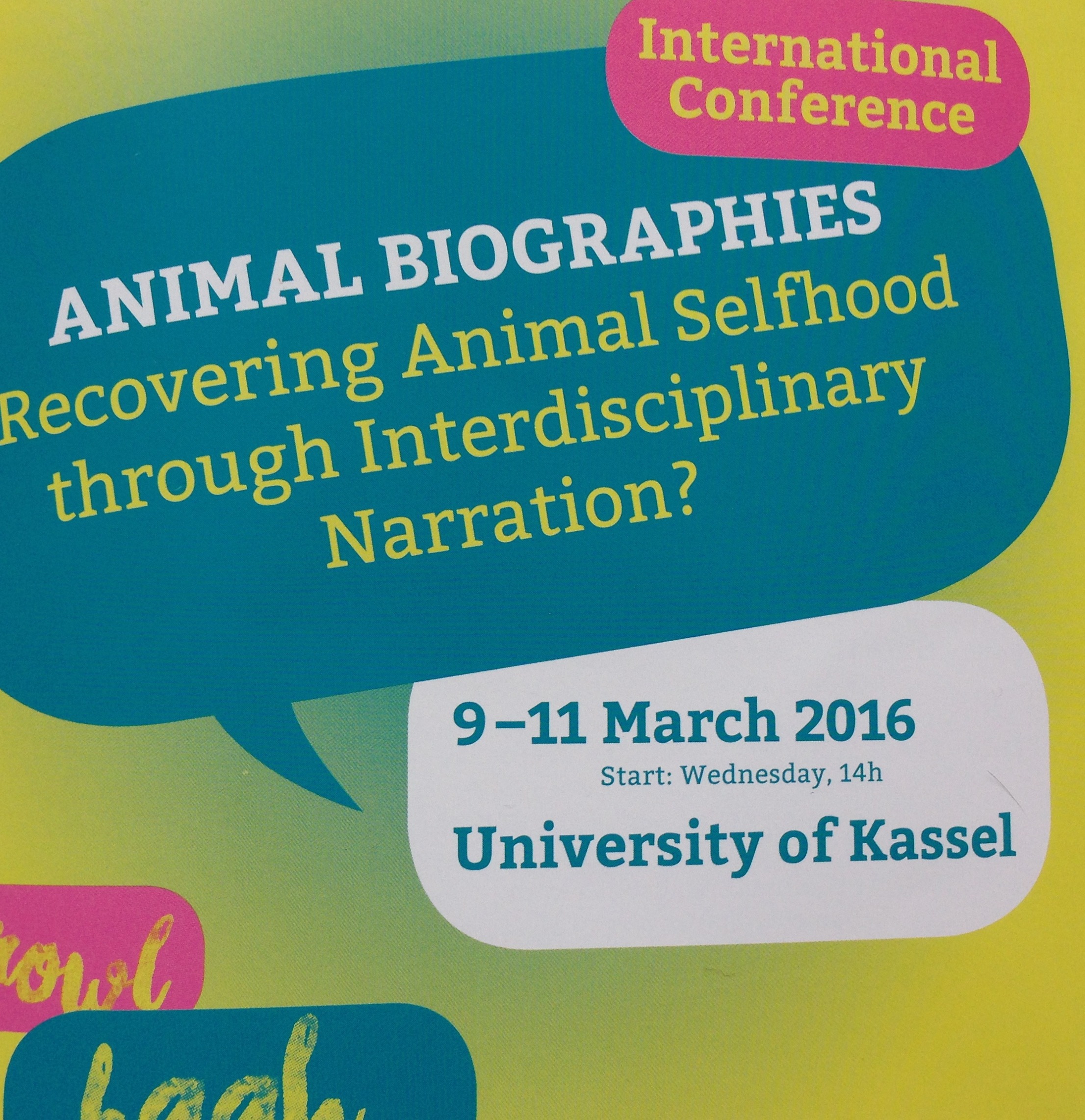 During February and March I am a Wissenschaftliche Gäste of sorts at the Universität Kassel’s Tier-Mensch Gesellschaft. I’m doing some research in the dOCUMENTA Archiv, finishing up a chapter in my dissertation, and giving a talk at this first-of-its-kind conference, “Animal Biographies: Recovering Animal Selfhood through Interdisciplinary Narration?”.