
by Jean Marie Carey | 24 Dec 2013 | Art History, Franz Marc, German Expressionism / Modernism, LÖL, Re-Enactments© and MashUps
August Macke, Märchen (Sindelsdorf), 1911, Gouache, Deckweiß, Aquarell August Macke, Märchen (Sindelsdorf), 1911, Gouache, Deckweiß, Aquarell
Franz Marc note to August Macke:
19.12.1910
Sindelsdorf
Du Gauner und alter Kulissenschleicher,
schwelge nur ruhig in den Kulissengeheimnissen anderer, einmal und zwar bald, (hörst Du?), musst Du auch aus Deinen Kulissen heraus vor die Rampe, dann schleich ich hinter Dich und beseh mir die Garderobe dieses Genies. – Übrigens lasse ich jetzt einen F …. nach dem anderen in meiner Malerei, – hörst Du sie nicht? Dröhnend!! Ich rechne nicht mehr auf den Besuch der Leute vor Weihnachten und werde also Deine Sachen nächstens zusammenpacken; es tut mit wahrhaftig leid, – sie sind mir so vertraut und lieb geworden. Soll ich die Sachen von Helmuth auch alle dazupacken? Vielleicht schicke ich das gerahmte Stilleben einmal eigens, wenn es Dir damit nicht eilt. Schreib mir bitte darüber. Grüsse Frau Lisbeth herzlichst. Viel Glück und ›Mut‹! zum Einzug in’s Atelier!
Dein Fz. M.
• • •
Although FM kind of jokes here about it perhaps being time for Helmuth Macke – who has only just arrived – to depart, FM quickly gets used to having Helmuth around. At the end of the same month, the nurturing, self-possessed teenager makes art history happen…
by Jean Marie Carey | 8 Dec 2013 | Animals, Animals in Art, Art History, Franz Marc, German Expressionism / Modernism
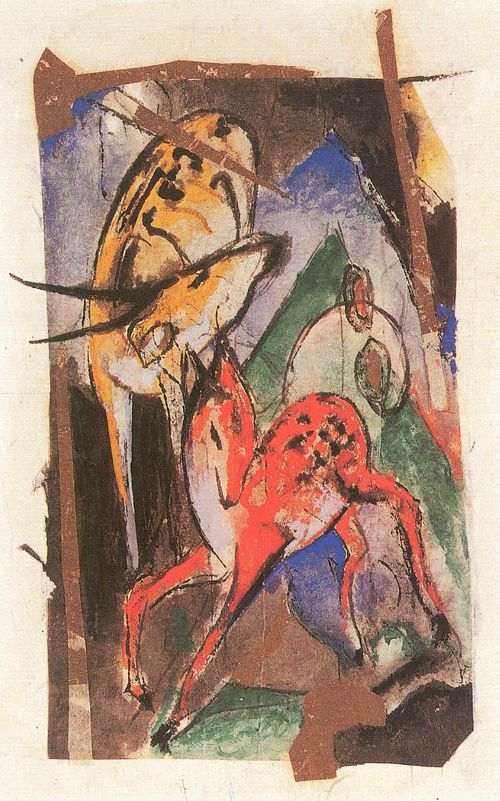
Franz Marc, Rotes Reh und gelbe Antilope, 1913, Mischtechnik und Collage (Silberpapier)
So, Franz Marc always said he was from the future…he amended the amount of how far in the future to 50, then 150, then “about 150 to 500 years” as his own time ran out, and often when saying this was expressing a complaint about his contemporaries that in 2013 we could characterize as: Haters gonna hate.
The recent (and continuing unabated in München) interest over the paintings stolen and hoarded by Hildebrand Gurlitt and his son, Cornelius Gurlitt, has turned to a conversation about the meaning of ‘ownership’ of priceless artworks probably at the very, very, very least obtained via coercive means, and the role of art dealers in the procuring of art and broker of deals for artists.
I began to think about this discussion, in an earlier version though informed by perspicacity, in terms of Marc, who always had a lot to say about art dealers, ranging from the fatalistic to a kind of grudging respect to affection and back, in the case of Hans Goltz, to sputtering but somewhat amused indignation. It seemed beyond the realm of possibility that Marc had encountered the Gurlitts, as Hildebrand Gurlitt was not born until 1895. However I should learn never to ‘bet’ against Marc’s knack for knowing somehow what someday would be meaningful. So, of course he knew the Gurlitts, in the form of the Fritz Gurlitt Gallery, through the eponymous owner and Fritz Gurlitt’s son, Wolfgang (the first cousin of Hildebrand), who had taken over the Berlin gallery and brokerage in 1907.
I was very excited to discover in revisiting Marc’s correspondence with August Macke the followng passage, in which Marc describes his interaction, with Wolfgang Gurlitt (the entire letter follows the break):
Sindelsdorf bei Penzberg, den 12. III. 13 Oberbayern
Lieber August,
… Das Beispiel Pechstein ist für mich typisch. Ich habe kein reines Gefühl mehr vor seiner Persönlichkeit. Mir ist höllisch Angst vor einer Popularität wie der seinen. Nolde tut auch keinesfalls mit, die ›Brücke‹ hat sich bis jetzt auch gesträubt. Aber was die tun, ist mir schliesslich auch nicht ausschlaggebend; wenn sie mittun, ist es ›der Not gehorchend, nicht dem eignen Triebe‹. Meier-Graefe hielt letzthin in München einen Vortrag, in dem er uns alle als Geschäftsmacher bezeichnete und das Publikum aufforderte, es solle sich gegen uns verbinden etc.!! Und Cassirer denkt im Grunde genau so. Mit diesem Kreis will ich nichts zu tun haben. Ich habe die Erfahrung gemacht, dass, wer was von mir haben will, zu mir selber kommt. Wer sich für mich und uns alle interessiert, geht sehr wohl in den ›Sturm‹ und kauft auch dort; der ›Sturm‹ ist als Ausstellungsraum glänzend, riesengross, gutes Licht, dunkle Wände; Ich hab recht gut dort verkauft; tout Berlin braucht gar nicht hinzugehen, ist mir viel lieber so. Gurlitt bedrängt mich seit Monaten, ich soll doch nur bei ihm ausstellen; ich habe ihm jetzt durch Niestlé sagen lassen, wenn er mich durchaus für seinen Salon braucht, soll er mit kaufen anfangen. Auf dem Ohr scheint er aber taub zu sein; wozu soll ich dann bei ihm statt im ›Sturm‹ ausstellen? Ich war dreimal in Berlin (wegen Niestlé) dort und habe, glaube ich, einen einzigen Besucher dort getroffen. Legros war ebenfalls öfters in der Niestlé – und gleichzeitig Pechstein-Ausstellung und traf nie einen Menschen dort. Wenn was Interessantes dort ist, geht man hin, so gut wie in den ›Sturm‹. Tu Du, wie es Dir am besten scheint; ich will mich zurückhalten; ich fühle es als Pflicht gegen meine Ideen über das Ziel unserer Arbeit, das nicht über den Weg der Berliner ›Sommerausstellungen‹ zu erreichen sein wird. Du schimpfst oder lachst, – ich bin nun einmal so. Dass Du Kandinskys Vier Klänge ›schlecht‹ findest, ist mir vollkommen unverständlich; ich denke das Gegenteil: sehr gut. …
One of the things I always like about Marc is that although he is (vaguely) aware of the practical importance of money and often worries about not having any, neither can he be easily enticed or motivated by it (no one seems ever to tried the ‘immediate gratification’ tactic of food, alcohol, cigarettes ‘oder sonst was.’). Also, for a mostly guileless and impetuous person, Marc could sometimes machinate fairly well…
Here Marc tells August of Gurlitt’s persistence in trying to have some dealings with him. On the one hand, Marc doesn’t really have any intention of bailing on the Der Sturm enterprise, but on the other, he wants to keep a line into Gurlitt on behalf of his longtime friend, neighbor, and fellow animal lover and animal painter, Jean-Bloé Niestlé, whose drawings of birds, while very skillful, fell somewhat outside the concern of the avant-gardes. He says Gurlitt actually seems a bit out of it in terms of critical culture, and that, further, no one ever seemed to be at the gallery anyway. It’s interesting that Marc expends a lot of effort trolling Gurlitt for Niestlé, and also that (this is a long and very affctionate letter) that he takes the opportunity to inject a comment preemptively defending Wassily Kandinsky to August, who was not a fan: ‘I think the opposite: very good.’
Actually, in the next few months, the Gurlitt gallery, which had already seen the first and only Brücke group show in 1912, will have a very successful Henri Matisse solo show, followed in 1914 by consecutive spaces devoted to Ernst Ludwig Kirchner, Erich Heckel, and Karl Schmidt-Rottluff, and the handling of all of Lovis Corinth’s prints, and printing portfolios and catalogues of work by Pechstein and Oskar Kokoschka. This probably goes to show that Marc was right to trust his instincts…
In any case it is quite amazing that Marc was very aware of the family who would one day sell Tierschicksale to Kunstmuseum Basel (still waiting to hear the explanation for that) and keep a Blauen Pferde hidden for seven decades. I picked this multimedia print work by Marc because it was made almost exactly 100 years ago, when Marc wrote this letter to August. It’s also very unusual for Marc in that it is truly a collage – the animals are cutouts from another print, and the brown spots are pieces of colored paper.
(more…)
by Jean Marie Carey | 5 Dec 2013 | Animals, Animals in Art, Art History, Dogs!, Italian Greyhounds, Re-Enactments© and MashUps
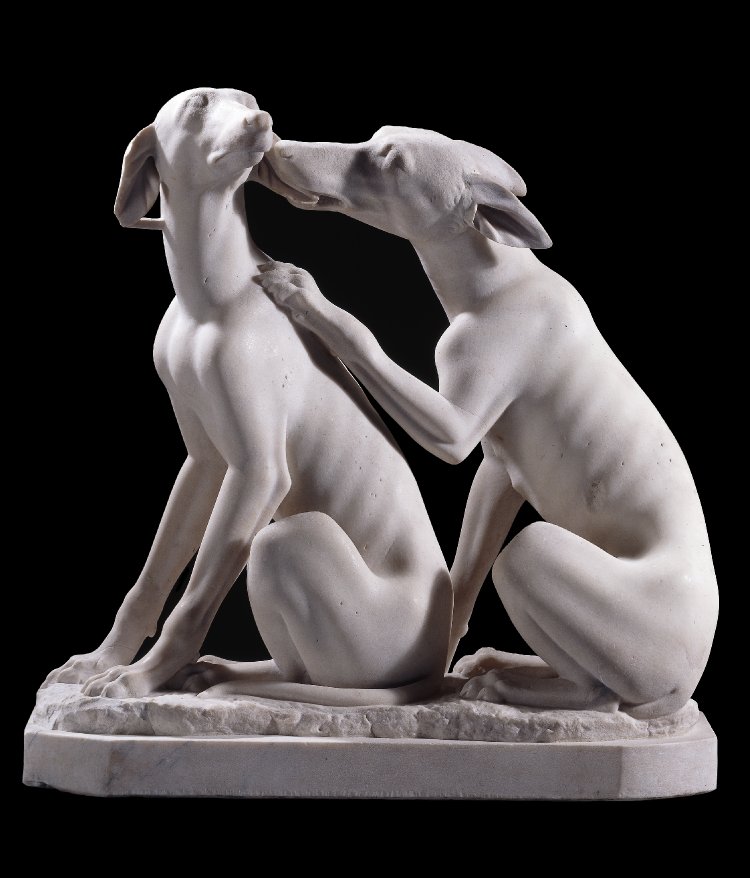
The Townley Greyhounds
The artistic expression of human relationships with animals has been and remains deeply complex and shifting. From the shaggy predators of the Lascaux Cave paintings to the costumed, hyperreal Weimareiners in the photos of William Wegman, the canine form has been especially popular with artists as both an ad hoc subject and a highbrow icon. A particular type of dog, the Cirneco dell Aetna, or Italian Greyhound, appears quite often in the art of ancient Greece and Rome, enjoying a commonality shared only with cattle and horses.
The Italian Greyhounds, however (as we shall call them henceforth), literally crossed the threshold in the ancient world, entering households not as steeds for work and war or sacrificial offerings, but as companions and objects of beauty.

The aim of this paper is to point out for consideration some examples of Italian Greyhound imagery from several ancient eras and geographical locations, to describe the history of this breed of dog in relation to its popularity in Greece and Italy, to draw a few conclusions about the dogs’ visual evolution and the reasons for its prevalence, and to show how both the animal and its image continued as both an influence and a viable species beyond the end of the Roman Empire. A starting point is to describe the nature and appearance of the Italian Greyhound, a species which exists fundamentally unchanged from its earliest days.
(more…)
by Jean Marie Carey | 2 Dec 2013 | Art History
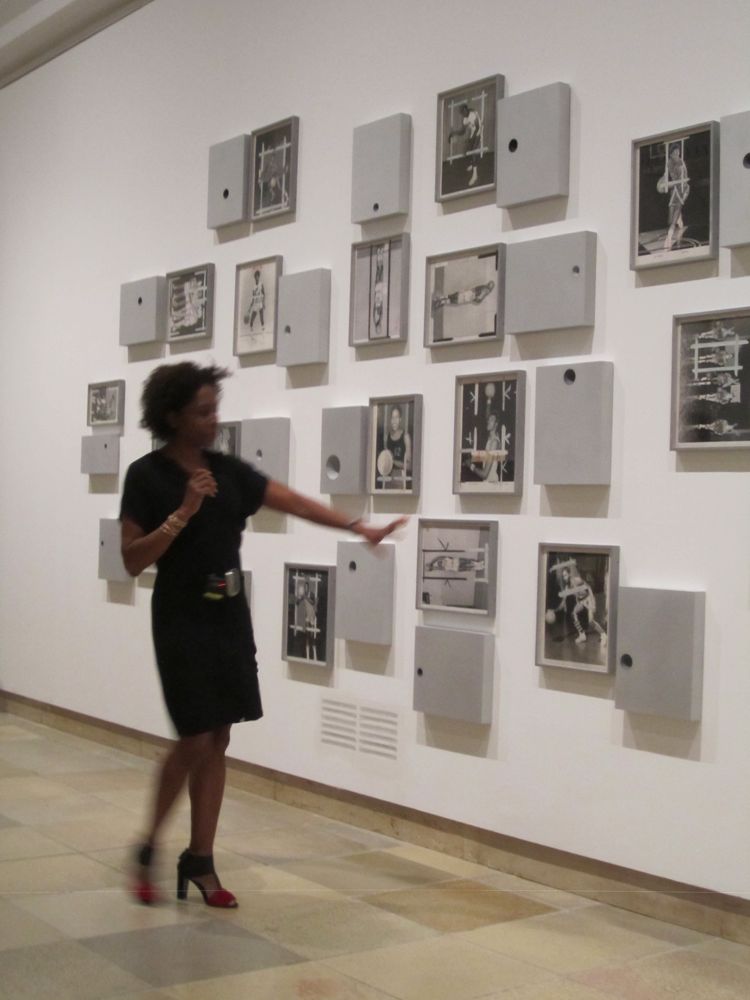
Lorna Simpson @ Haus der Kunst
One of the aspects of Lorna Simpson’s work I have always admired is the technical quality of her photographs. At her recent press conference at Haus der Kunst she confirmed what you’d expect from examining the gelatin prints in particular but really, upon close in-person inspection, her oeuvre: that Simpson develops, prints, mounts and even frames most of her photos by herself in a darkroom/studio in New York City.
This sort of mid-career retrospective represents more than 30 years of of photography, film, video, and drawing. Known (as in these photos have entered the canon) for her mid-1980s for her language driven large-scale works combining photographs and text, Simpson’s effective enigmas are clearly coded but spacious enough to still wonder about. One of the most interesting works on view in München are a series from the 1990s of large multi-panel photographs printed on felt, accompanied by text panels describing their locations and the intimate encounters that are described but only hinted at visually. At the edge of the Englischer Garten where something exactly as described is probably happening right now only not as well concealed, the effect was actually humane and tender as opposed to amusing. The exhibit, which unfortunately overlaps with some other very strong show and with Haus der Kunst’s interactive festival also showcases Simpson’s film and video works, a group of watercolors, and an archive of found photographs from the 1950s, which Simpson has embellished by creating replicas of, posing herself to mimic the originals.
