
Edification in the Conservatory
Danaé Xynias’s “Weite Fluren” is a good match for the Orangerie.
In framing the composition of a landscape painting, the challenge to the image maker, following eons of tradition, comes down fundamentally to where to place the horizon line. Contemporary painters have toyed with this problem experimentally, such as in Colin McCahon’s various large-panel installations of volcanic vistas in New Zealand. At the far reaches of these modern manifestations falls Trevor Paglen’s Covert Operations and Classified Landscapes (2010) presenting the horizon as, also, metaphorically unreachable. To sort of put things back into perspective, so to speak, Danaé Xynias makes the brave choice to return to the subject of landscape painting – the meeting of land (or water) and sky – allowing the horizon line to settle for the most part naturally in the center of her canvases.
Xynias’s current exhibition, “Weite Fluren,” is a mixture of landscapes and stylized still-lifes. (The still-lifes are certainly interesting in their own right, with rounded forms of pumpkins and melons against a zero-depth background intensifying the relationship between subject and frame.)
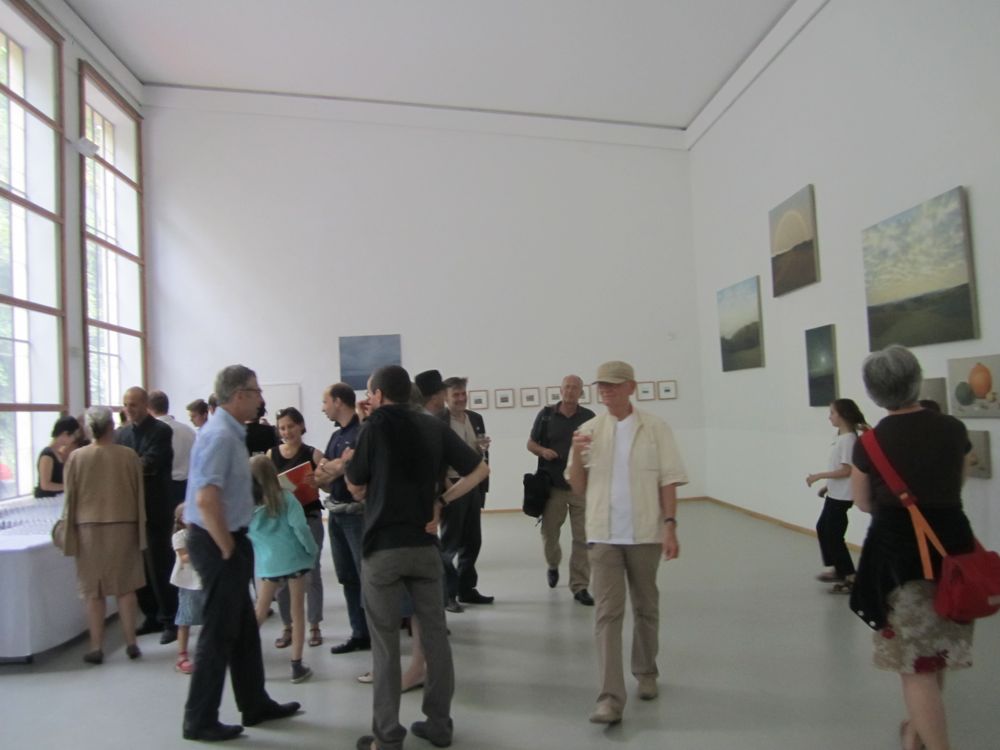
A reference in the catalog for the show marks an oblique historical lineage by referencing both Caspar David Friedrich and Jacob van Ruisdael, demurring that Xynias doesn’t quote them directly. This is true, though particularly the low clouds often associated with the van Ruisdael family are a clear evocation of the past. Make no mistake though Xynias is strictly a modernist, in the sense that her facture is very clean, the painted surface entirely flat and removed from the content in careful application. The space Xynias makes reference to in the exhibition title is obviously something that is of keen interest in its totality to the painter, a graduate of the Kunstakademie Düsseldorf who practices in a remote studio in Niederbayern. “Weite Fluren” is luminous in its incarnation at the Orangerie in the Englischer Garten, the classicizing space with the summer-lush exterior always at the peripheral always in view. The show is hung simply, without name markers as a distraction, with the larger landscapes singly or in groups slightly above eye-level, making visitors have to look “up” into the skies of the paintings.
