
by Jean Marie Carey | 29 May 2008 | Art History
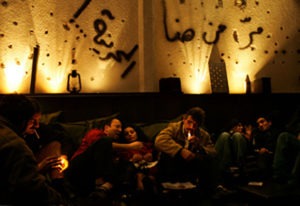 Nightclub in Beirut, Lebanon (Stephanie Sinclair, 2005)
In July of 2006, during a bout of intense border battles between Israeli armed forces and members of Lebanon’s Hezbollah militia, a photograph made by Stephanie Sinclair achieved a broad second life on the Internet when it accompanied a post on food writer and Travel Channel star Anthony Bourdain’s blog; Bourdain and crew had been filming an episode of No Reservations in Beirut and were “trapped” in the city owing to the destruction of the airport and an naval blockade effectively halting departures by Americans from the Gulf states. The photograph had originally appeared on March 12, 2005, in the Travel section of the New York Times with a story by Scott Spencer about the nonchalant nightlife scene in Beirut following the assassination of Lebanese prime minister Rafik Hariri. The image was described in the Times as “Love among the ruins at the war-themed Beirut club known as 1975,” and on Bourdain’s blog with the following caption: “Prewar partygoers enjoy the music and atmosphere at 1975, a bar whose theme is the country’s civil war.”
The odd syntax of the cutlines suggests that “the war” was an omnipresent future, past, and present entity. Regardless of the date the image was made, though, its placement in the context of stories about a “live,” ongoing military flare-up, even amid the larger ceaseless tragedy in the Middle East, makes the powerful suggestion that Beirutis party even as rockets and air strikes devastate the buildings around them.
(more…)
by Jean Marie Carey | 26 May 2008 | Animals, Animals in Art, Dogs!
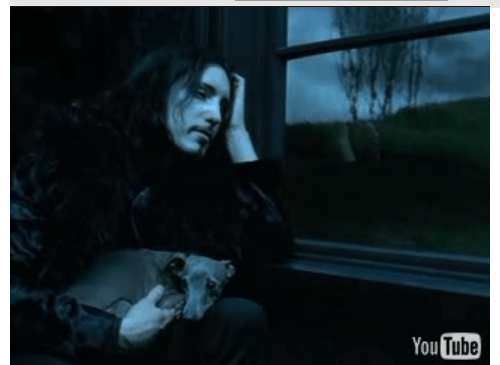
Though Trent Reznor allegedly dislikes this video and will not perform “The Perfect Drug” live, here is further proof, as if any is needed, that this is one of Nine Inch Nails’s best efforts.
by Jean Marie Carey | 18 May 2008 | Art History
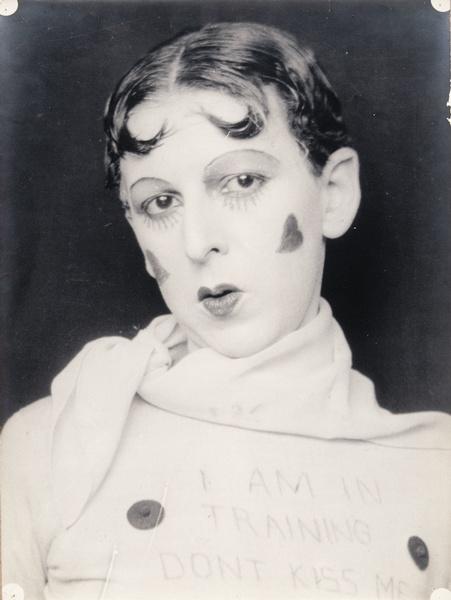
Claude Cahun Self Portrait, 1927. Collection Musée des beaux-arts, Nantes.
In her essay “In Our Glory: Photography and Black Life,” bell hooks uses a story about the relationship she and her two sisters “V.” and “G.” have to a photograph of their father, Veodis Watkins, taken before the girls were born, to set up a general dialogue about the function of snapshot collection displays in African American households and the role these photos play in construction and possession of black identity. Though a very prolific writer who mostly espouses disengagement from the concept of “the enemy,” hooks frequently chooses unusual adversaries (among them rapper Lil’ Kim and filmmaker Wim Wenders). In “In Our Glory” hooks’s rival is her sister “V.”
(more…)

by Jean Marie Carey | 4 May 2008 | Art History
“Ghost Ship (Deliver Us)” by Gremlins CC, Burnham on Sea Carnival 2006
“It seemed that she was trying to convey to me a message of her sadness.”
Herve Guibert’s essay “Ghost Image” is the text that accompanies a non-existent photograph; the implication being that if the photo did exist, and were, for example reproduced with an essay (one that would obviously not be titled “Ghost Image”) the text and photo would create a sort of “proof” that the image and the back-story of its creation made for a unified true account of the photograph’s origin.
Instead “Ghost Image” is the story of a botched photograph that seems to haunt Guibert so acutely the memory is as real, or more real, than if the shot had been successfully recorded. In fact, in either scenario, what is being presented as Guibert’s straightforward autobiographical recollection may be an inaccurate memory, a magnified, dramaticised partially true story, or a completely fabricated incident. The existence of the photo, or its lack, have little bearing on the essay.
Setting aside Guibert’s apparent disdain for his parents’ conventional marriage and lifestyle, Guibert is talking about, on some level, the relationship between photos, writing, and memory. Taken more at face value, Guibert’s remaking of his mother in an image that is to his – but maybe not Mme. Guibert’s – liking is about control, but also about rejection and reinvention of the self. Guibert creates distance between himself and his mother through his careful construction of “a look” and “a scene,” but also a sense of intimacy that is not entirely lacking in dignity and affection. His haughtiness seems to conceal both a deep, unquenchable discontent and a desire for recognition of himself as someone removed from his family’s middle-class affectations – phantoms are not of this world of course and maybe it is Guibert who is the ghost.
Though it is easy to become annoyed Herve Guibert’s caustic statements about his mother’s fading appearance and thus her viability as a female being, these asides are a red herring to Guibert’s inquiry into the “reality” of the photo world. Beyond that, Guibert himself died a full decade before he himself would have been his mother’s age at the time the “ghost image” was (not) made. This is melancholy-making too; Guibert ends up in history being pegged as a sort of hanger-on to noted philosophers. These youthful writings give many hints that Guibert was deliberately fashioning himself as a sort of scolding, multi-faceted journalist-artist (like Andrew Sullivan) who probably would have, at some point, abandoned the extreme autobiography for a more compassionate voice.

 Nightclub in Beirut, Lebanon (Stephanie Sinclair, 2005)